ALEX KANOS

STREET ART MURALS

ALEX KANOS

STREET ART MURALS

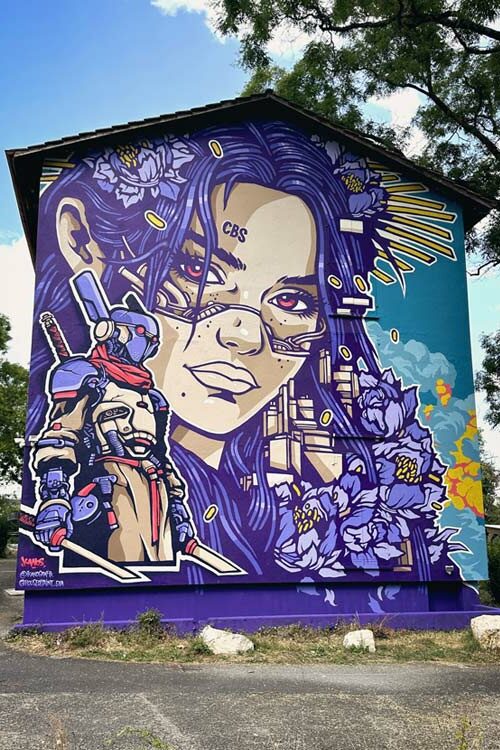
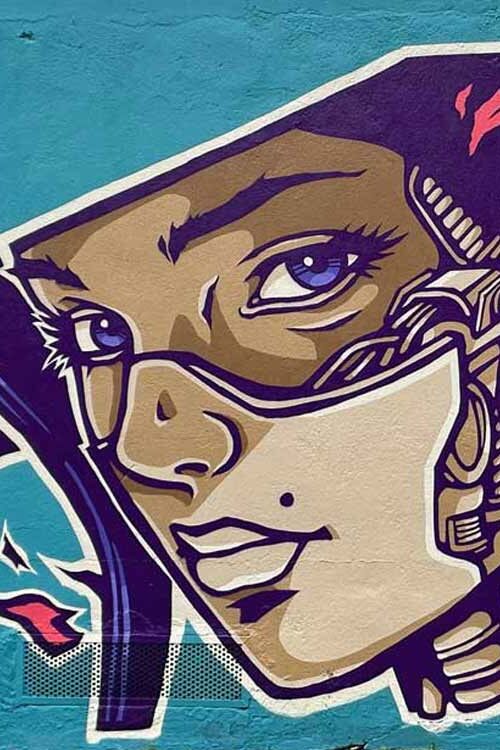
Alex Kanos is painting a contemporary cyberpunk Art Nouveau mural showing is experience

What Is My Experience?

My name is Alex Kanos, a French mural artist and visual designer based near Paris. Since childhood, drawing has been more than a passion—it has been a way of observing and understanding the world. Long before I painted large-scale walls, I was fascinated by architecture, maps, typography and the visual language that shapes our cities. Those early interests gradually evolved into an artistic practice where mural painting, graphic design and urban culture naturally intersect.

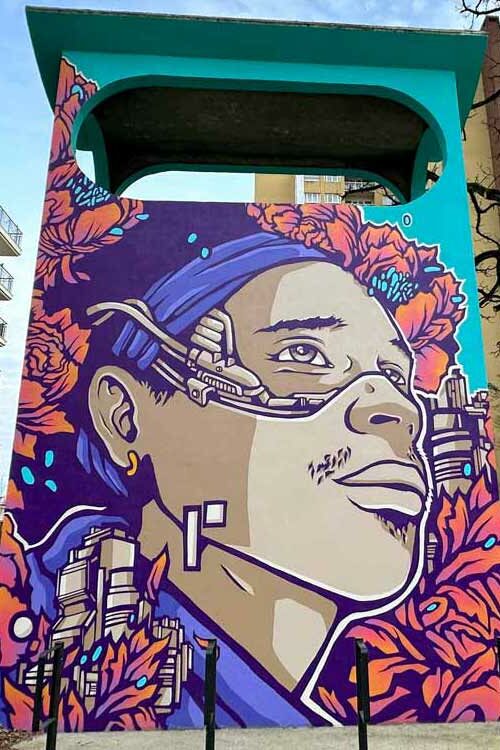
Today, my work is recognised for combining contemporary figurative murals with cyberpunk aesthetics and decorative influences inspired by Art Nouveau. Although my visual language has evolved considerably over the years, every stage of my journey has contributed to building the artistic identity that defines my work today.

The begininngs

My introduction to graffiti came in 1999 while I was still in high school. At that time, graffiti represented far more than lettering or urban intervention. It was an entirely new visual language, offering freedom of expression on a monumental scale. Painting walls taught me lessons that no classroom could provide: how to compose images for large formats, how to work with architecture instead of against it, and how to adapt quickly to constantly changing environments.

These first years also developed a lasting fascination for cities themselves. Walls, abandoned factories, railway infrastructures and industrial districts became both my studio and my source of inspiration. Rather than seeing them as empty surfaces, I began to consider them as living environments carrying traces of history, transformation and human activity.

This relationship with the city still influences my work today. While my current murals have moved beyond traditional graffiti aesthetics, they continue to explore urban environments through architecture, layered compositions and visual storytelling.

Academic journey and artistic formation

After completing a scientific baccalaureate, I chose to dedicate myself entirely to visual arts by entering public Fine Arts schools in France. During five years of higher education, I developed both traditional artistic skills and advanced digital techniques, eventually graduating with both the DNAP and DNSEP degrees with honours.

These years fundamentally transformed my approach to image-making. Alongside painting, I explored graphic design, typography, photography, animation, video production and digital composition. Learning professional software such as Photoshop, Illustrator and After Effects expanded the possibilities of my artistic practice and encouraged me to move freely between physical and digital media.

My graduation projects already focused on themes that continue to shape my work today: urban perception, the visual organisation of cities, mapping systems, labyrinths and the accumulation of signs within public space. Rather than separating graphic design from fine art, I began developing a multidisciplinary practice where each discipline strengthened the others.

One of these research projects eventually became Paris Undaground, an experimental interface exploring the hidden underground networks beneath Paris. Another led to 48Nord 2Est, an urban intervention revealing invisible infrastructures directly within the streets themselves. Although these projects differed from mural painting, they established a methodology that still guides my work: observing the city, revealing hidden narratives and transforming them into visual experiences.
Download my resume
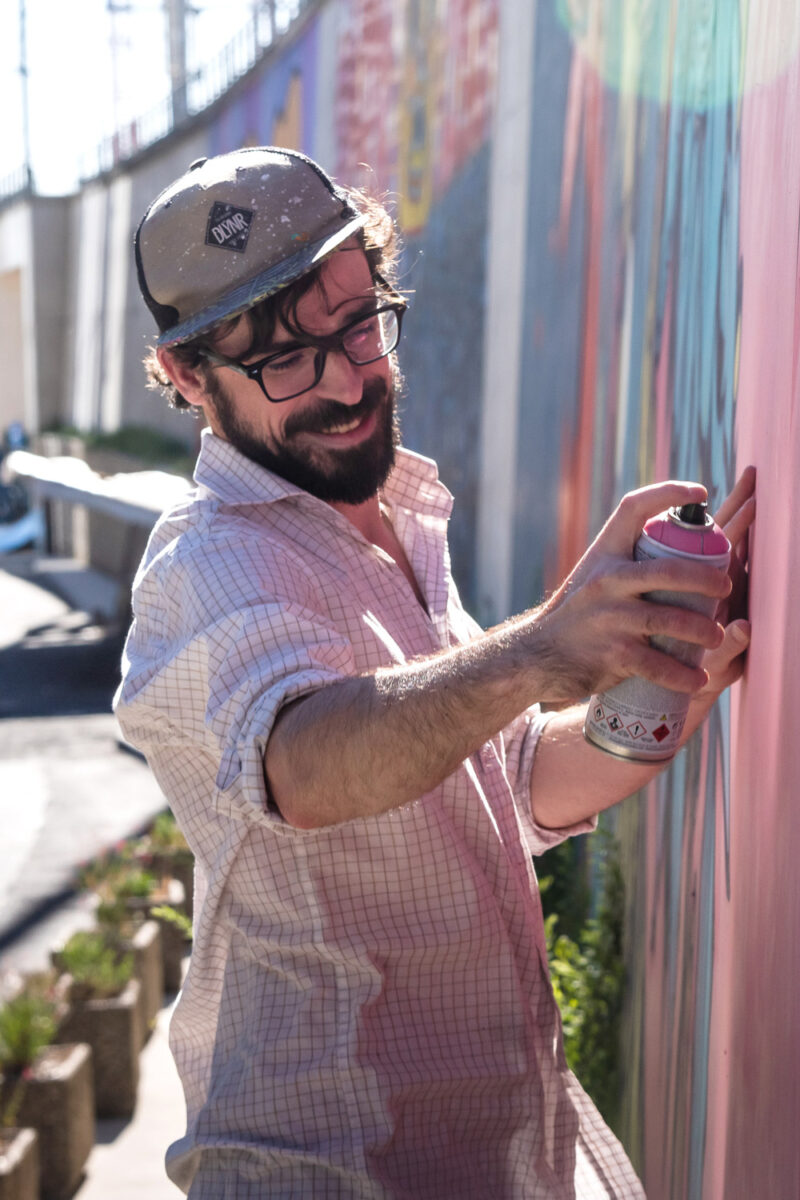
Alex Kanos is holding spray in his hands
Emergence and Innovation

While my academic education provided strong conceptual foundations, my artistic career accelerated through experimentation. During my studies, I developed a project that would unexpectedly gain international attention: CelloGraff.

Created in 2006, CelloGraff proposed a simple yet radical idea. By stretching transparent cellophane between elements of urban furniture, it became possible to create temporary painting surfaces almost anywhere in the city without permanently altering the environment. This ephemeral support transformed ordinary public spaces into unexpected places for artistic intervention.

The project quickly attracted widespread media interest and introduced my work to audiences far beyond the graffiti community. More importantly, it demonstrated my interest in questioning not only what is painted, but also where and how art can temporarily exist within public space.

This period marked the beginning of my professional career. It also confirmed an approach that still defines my practice today: combining technical experimentation with strong visual identity while constantly seeking new ways of interacting with architecture and urban environments.

International Exploration and Experience

As my work became more visible, opportunities to paint abroad multiplied. Travelling rapidly became an essential part of my artistic development, allowing me to encounter different cultures, urban landscapes and artistic communities.

These experiences led me to collaborate with artists throughout Europe, North America and Asia. They also resulted in my integration into the CBS Crew in Los Angeles, where I had the opportunity to exchange ideas with internationally recognised graffiti writers and mural artists. Each destination offered new perspectives, not only on artistic techniques but also on the relationship between cities, architecture and public art.

International festivals played an important role in this evolution. Painting alongside artists from different countries worldwide encouraged constant experimentation and reinforced my belief that mural painting could function as a universal visual language beyond linguistic or cultural barriers.

Travelling also profoundly influenced my imagery. Urban density in Asia, industrial landscapes across Europe and the visual culture of American cities gradually enriched my compositions. Rather than copying these environments, I integrated fragments of their atmospheres into my own visual vocabulary, contributing to the transition from lettering towards increasingly narrative and figurative murals.

From Graffiti to Contemporary Murals

Over time, my practice progressively moved away from traditional graffiti lettering toward more complex visual constructions centered on characters, environments and narrative tension. This shift did not represent a rupture, but rather an expansion of the visual language developed during my early years.

The discipline of graffiti, its speed, adaptability and relationship with public space, remains deeply embedded in my approach. However, my current work explores broader pictorial possibilities, integrating figurative elements, architectural fragments and symbolic compositions within large-scale murals.

A central evolution in my practice is the introduction of the character as a narrative anchor. Rather than focusing solely on typography, my murals now often depict human or humanoid figures embedded within dense visual environments. These figures act as mediators between organic forms, mechanical structures and architectural spaces.

In parallel, my visual language increasingly draws from contrasting aesthetic references. On one hand, cyberpunk culture provides a framework for imagining dense, technological and often dystopian urban environments. On the other, Art Nouveau, particularly the work of Alphonse Mucha, offers a structural approach to ornamentation, composition and flow.

This combination creates a tension between organic elegance and industrial density, between historical decorative systems and speculative urban futures. It is within this tension that my current visual identity has developed.

Rather than illustrating a specific narrative, my murals often function as fragments of visual worlds. Each composition suggests an expanded environment beyond the frame, where architecture, nature and technology coexist in unstable balance.

Today and Beyond

Today, I work primarily as a mural artist and visual designer, developing large-scale projects for cities, institutions and cultural events. My practice combines mural painting, illustration and graphic design, allowing me to move between physical walls, printed media and digital composition.

My current research focuses on contemporary figurative murals inspired by cyberpunk atmospheres and Art Nouveau structural principles. This combination allows me to construct images where ornamental design meets urban density, and where characters exist within complex visual ecosystems.

I continue to collaborate with municipalities, cultural institutions and private clients for commissioned murals, visual identities and public art projects. Each commission is approached as an opportunity to integrate artistic vision into a specific architectural and social context, rather than simply applying a predefined style.

My work is also supported by ongoing personal research, documented through this website. These projects explore themes such as urban transformation, visual perception, layered cities and the relationship between organic and mechanical structures within contemporary environments.

Also you can find some of my work on my Shop online who provides Wear and Print item.

Download my resume

Frequently Asked Questions

Who is Alex Kanos?
Alex Kanos is a French mural artist and visual designer whose work combines contemporary street art, cyberpunk aesthetics and Art Nouveau influences.

What is your main artistic focus today?
Large-scale mural painting featuring figurative compositions, architectural environments and hybrid visual systems combining organic and mechanical elements.

How did your artistic career begin?
It began with graffiti in 1999 in the Paris region, which led to a long-term exploration of urban visual culture and large-scale painting.

Do you still practice graffiti?
Graffiti remains an important foundation of my practice, but my current work is focused on contemporary mural painting and visual design.

What influences your current work?
Cyberpunk imagery, urban architecture, Art Nouveau structures (notably Alphonse Mucha), and contemporary city environments.

Last blog posts

Find me on social network

InstagramLinkedin