
“Memoire de fin detudes” / Graphic Sign Studies
“Memoire de fin detudes” presents the research developed during my final year at art school in 2008. Rather than focusing exclusively on artistic production, this dissertation examines the city as a constantly evolving system of visual signs. It explores the relationships between people, urban space and graphic communication while questioning how cities produce, accumulate and transform meaning over time. Many of the ideas developed in this research later became the conceptual foundations of my artistic practice.
In 2008, the United Nations announced that, for the first time in history, more than half of the world’s population was living in cities. This historic demographic shift reinforced an observation that lies at the centre of the dissertation: the city is no longer simply a place where people live, but a complex visual ecosystem composed of countless signs interacting with one another.
Every journey through a city involves reading information. Street names, advertisements, traffic signs, graffiti, architecture, maps, commercial logos and public notices all contribute to an immense visual language that structures urban life. Most of these signs are perceived almost unconsciously, yet together they shape our understanding of the city and influence the way we move through it.
The dissertation approaches the city as a living text that can be interpreted through graphic design, cartography and semiotics. Rather than analysing architecture alone, it considers every visible mark as part of a larger communication system continuously rewritten by institutions, businesses and citizens.
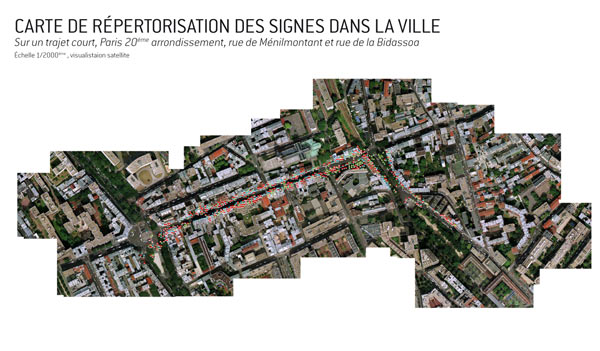
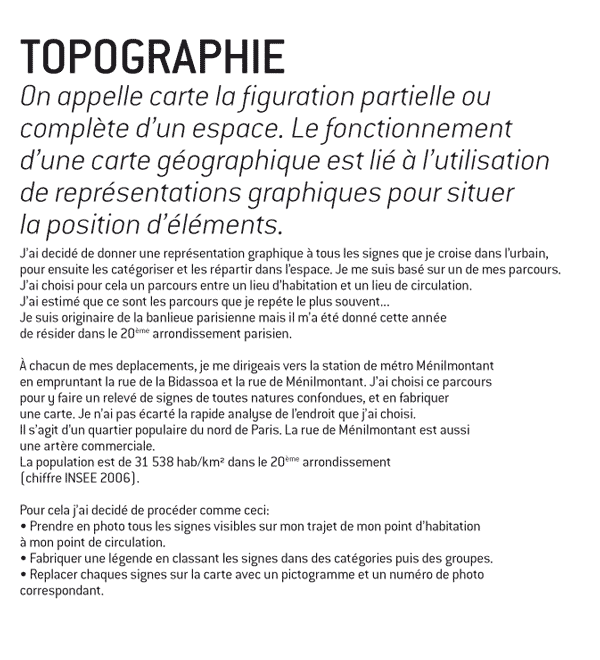
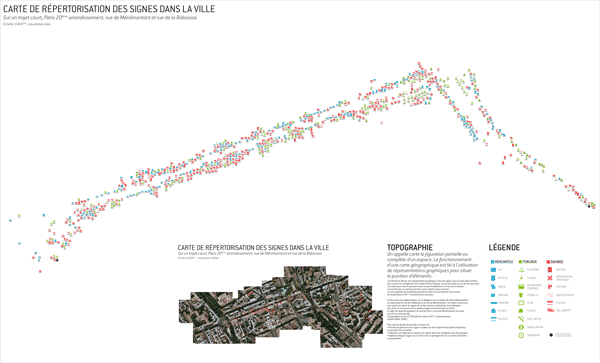
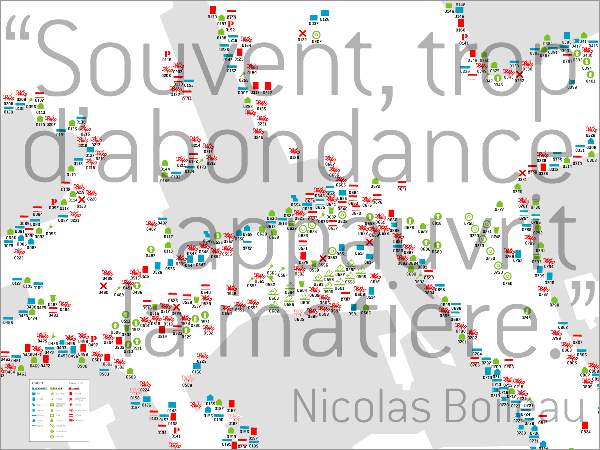
Cartography occupies an important place within this reflection. A map is not simply a technical representation of territory; it is a graphic language allowing space to become readable. Through symbols, abstraction and visual conventions, maps transform the complexity of the real world into navigable information. This interest in cartographic thinking would later influence projects exploring hidden infrastructures, underground Paris and urban labyrinths.
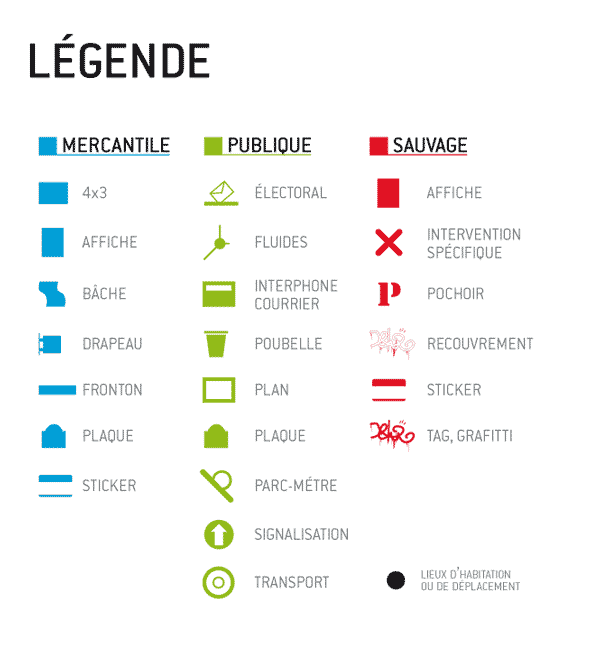
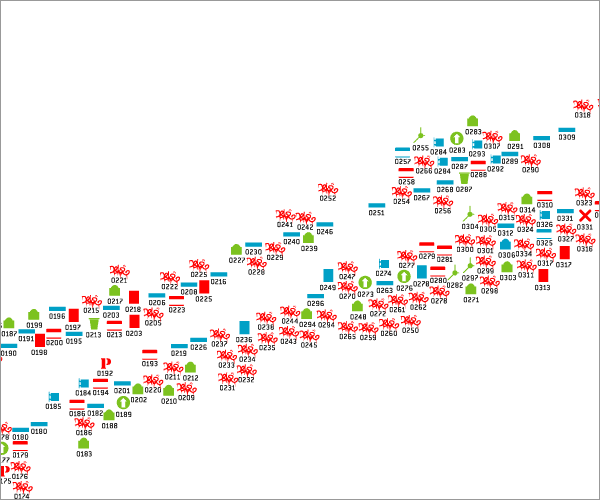
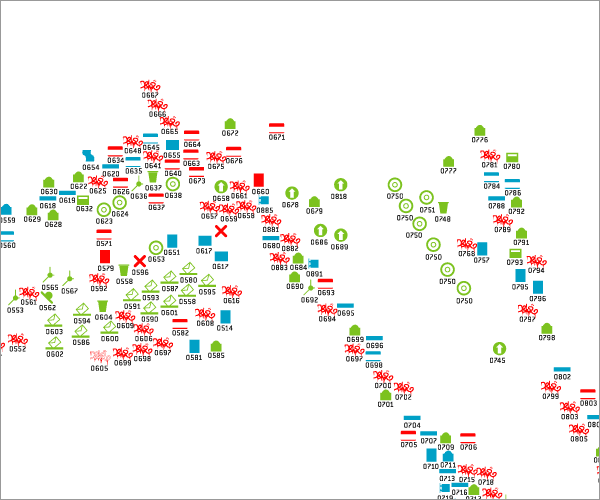
The dissertation proposes three major families of urban signs.
The first consists of institutional signs. These include road signs, public information, transport systems and official pictograms. Their objective is clarity. They rely upon internationally recognised visual codes that minimise ambiguity and facilitate orientation within increasingly complex urban environments.
The second category concerns commercial signs. Unlike institutional communication, commercial graphics seek to persuade rather than simply inform. Shop signs, advertising campaigns, branding and promotional imagery constantly compete for public attention. Their primary function is economic: attracting consumers through visual communication.
The third category is wild signs, including graffiti, tags and every form of unauthorised urban inscription. Although often considered illegal, these visual interventions represent another essential layer of the city’s graphic identity. They introduce personal, political, artistic and social expression into public space, creating a dialogue with institutional and commercial communication.
A major section of the dissertation traces the historical origins of these urban signs. Human settlements developed alongside the emergence of agriculture in Mesopotamia several millennia before our era. As societies became increasingly organised, written language gradually appeared to record names, exchanges and information. The growth of cities and the development of writing therefore evolved together.
Far from being a modern phenomenon, urban inscriptions have existed for thousands of years. Ancient graffiti discovered in places such as Pompeii reveal political opinions, personal messages, commercial advertisements, declarations of support for gladiators and countless traces of everyday life. These inscriptions remain invaluable historical documents because they preserve voices rarely recorded in official literature.
Other examples appear throughout history, from ancient Ephesus and Mayan cities to Viking inscriptions and early Christian catacombs. Across cultures and centuries, human beings have continuously transformed walls into spaces of communication, memory and identity.
This historical continuity profoundly influenced my understanding of graffiti. Rather than considering it solely as an act of transgression, the dissertation situates it within a much longer history of public inscription. Contemporary graffiti becomes one chapter in an ongoing human practice extending across civilizations.
One of the central conclusions of the dissertation is that every sign contributes to the collective memory of the city. Whether official, commercial or spontaneous, each visual intervention records something about the society that produced it. Cities therefore function as immense archives where successive generations continuously write, erase and rewrite their own history.
Looking back today, many projects developed after graduation—including research on urban mutation, disappearing graffiti, underground Paris, industrial landscapes and stop-motion animation—find their conceptual origins within this dissertation. Although the visual language evolved considerably over the following years, the central question remained unchanged: how do cities communicate through the countless signs they accumulate over time?
Memoire de Fin detudes therefore represents much more than an academic document. It establishes the theoretical framework that continues to inform my artistic practice today, connecting graffiti, graphic design, cartography, urban history and visual culture into a single reflection on the city as a living, evolving language.
You can find my thesis in Pdf format / It takes the form of a map, designed primarily as an object to be handled, it is therefore not well-suited to the web format.
Frequently Asked Questions
What is Mémoire de Fin d’Études about?
It is my final art school dissertation exploring the city as an evolving system of visual signs, graphic communication and urban memory.
What are the three categories of urban signs discussed in the dissertation?
The research examines institutional signs, commercial signs and wild signs such as graffiti and other unofficial urban markings.
Why is cartography important in this research?
Maps are presented as graphic systems that help us read, understand and navigate the complexity of urban space.
How does the dissertation relate to graffiti?
It places graffiti within a much longer history of public inscriptions, showing that walls have served as spaces of communication for thousands of years.
How did this research influence my later work?
The dissertation became the conceptual foundation for later projects about urban mutation, underground cities, industrial landscapes, cartography and the evolution of visual signs in public space.