
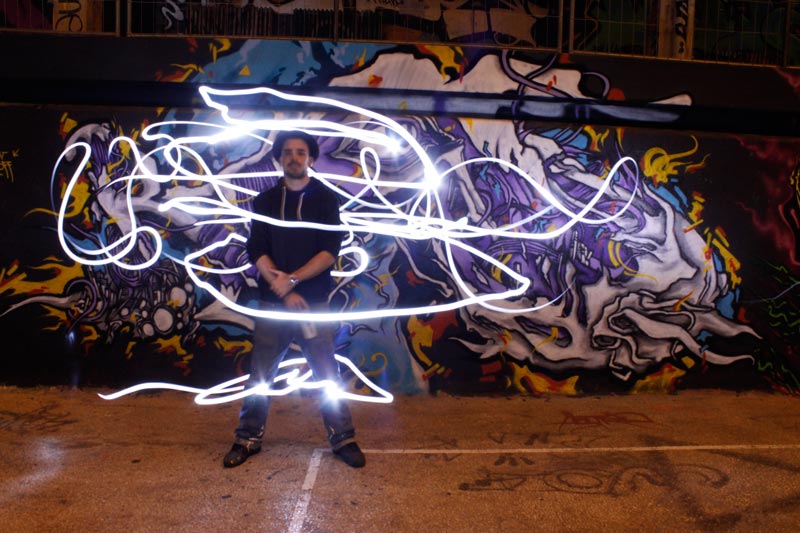
Piscine Molitor 2010 / Graffiti Painting Before Transformation
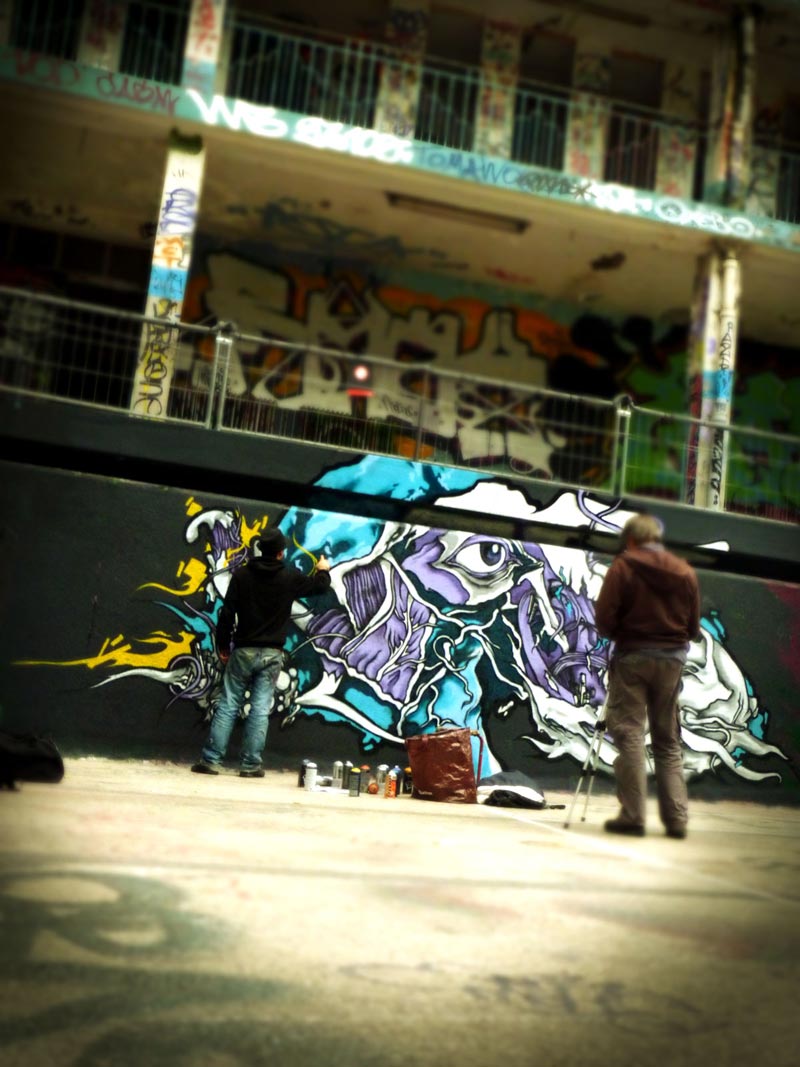
“Piscine Molitor 2010” documents my first graffiti mural inside the abandoned Molitor swimming pool in Paris. For many graffiti artists, Molitor was far more than an abandoned building. Before its complete renovation, it had become one of the most iconic urban art locations in Europe, attracting writers, painters and photographers from across France and abroad.
Every corridor, cabin and poolside wall evolved into a constantly changing open-air gallery where artworks appeared, disappeared and were replaced over the years.
Having the opportunity to paint inside Molitor during this unique period was a privilege. The building had already entered graffiti history long before its transformation into a luxury hotel. Its abandoned architecture, deteriorating surfaces and remarkable Art Deco structure created an atmosphere unlike any other place in Paris. Every intervention became part of a collective visual archive that existed only temporarily.
Today, this environment has completely disappeared. Following extensive restoration work, the former abandoned swimming pool has been transformed into a luxury hotel and wellness complex. The walls that once carried thousands of graffiti pieces have been cleaned, rebuilt or replaced. Visitors now experience an entirely different space, often without knowing that one of Europe’s most celebrated graffiti locations once occupied the same building.
This transformation directly echoes one of the central themes explored throughout my artistic practice: the continuous mutation of cities. Urban environments constantly erase, replace and reinterpret their own history. Graffiti, because of its temporary nature, often survives only through photography and collective memory.
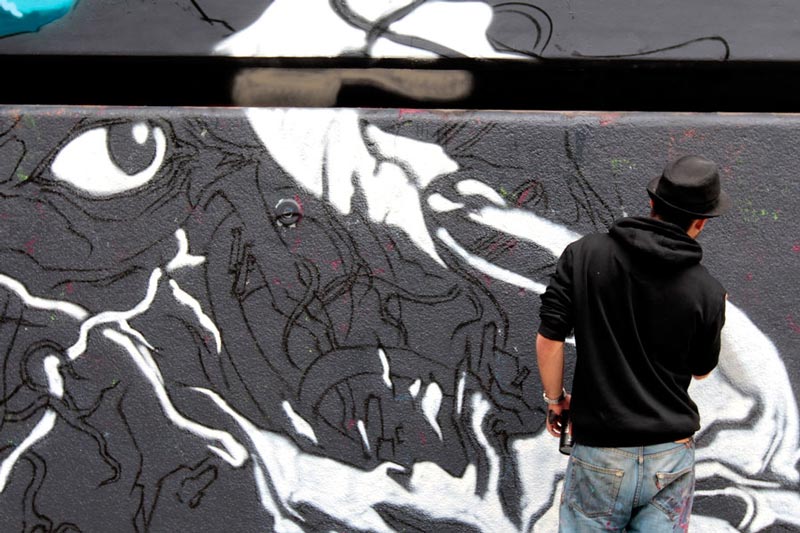
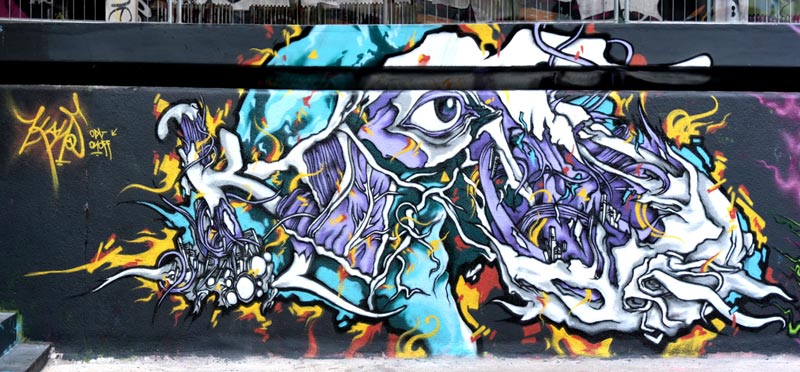
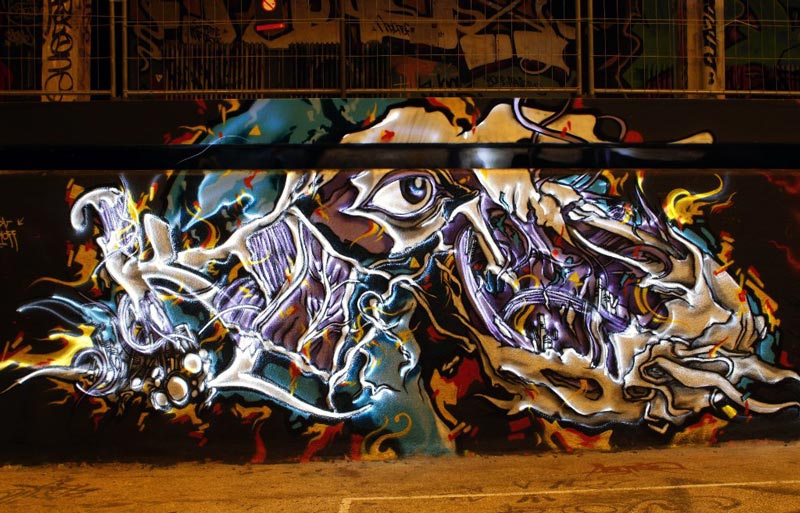
The mural presented in this article belongs to that disappearing history. Painted on a grey background, the composition combines graffiti lettering with organic figurative forms. Rather than separating text and image, both are fused into a single visual structure where letters gradually dissolve into living matter.
Organic textures spread throughout the composition, creating the impression that the mural itself is composed of flesh, muscles and biological structures. An eye emerges from the painted forms, observing the viewer while remaining partially absorbed by the surrounding material. Fragments appear torn away from the surface, revealing successive layers beneath, as though the painting itself were slowly eroding.
This visual language reflects research that was already developing across several projects during this period. My portraits increasingly integrated organic structures, while my graffiti lettering moved beyond traditional forms by incorporating living textures and fragmented surfaces. These experiments would later evolve further in projects such as the Kanos le billet d’un dollar series, where typography, architecture and organic elements became fully interconnected.
Looking back today, the mural acquires an additional meaning that was not necessarily explicit when it was painted. The organic fragments gradually disappearing from the wall can now be interpreted as a metaphor for Molitor itself. Just as the painted forms appear to erode and dissolve, the building that hosted them has also undergone a profound transformation.
This relationship between material disappearance and collective memory has become increasingly important within my work. Graffiti rarely exists permanently. Walls are demolished, buildings are renovated and entire neighbourhoods change function. What remains are photographs, documentation and the memories shared by the artists who experienced these places.
Molitor occupies a special place within that collective memory. For many members of the graffiti community, the abandoned swimming pool represented an extraordinary period of creative freedom. Each visit revealed new murals, new collaborations and new visual discoveries. The building itself became a constantly evolving archive where every intervention was destined to disappear beneath future layers or eventual redevelopment.
I later had the opportunity to return and paint again inside Molitor before renovation work finally began. Those successive interventions became part of the final chapter of the building’s graffiti history before its complete transformation.
This article therefore documents not only a mural but also a place that no longer exists in the form remembered by artists. The photographs preserve fragments of a cultural moment that has disappeared from the physical city while remaining alive through documentation and shared experience.
Finally, I would like to express my sincere gratitude to the photographers who generously documented this project and shared their images over the years. Their work has preserved artworks that no longer exist and continues to keep the memory of abandoned Molitor alive. My warmest thanks go to Anne Olofsson, Chrixcel, Brin d’Amour, RV Photograff92 and Francis Beddok for their generosity, their passion for documenting street art and their invaluable contribution to preserving this unique chapter of Paris graffiti history.
Frequently Asked Questions
What is Piscine Molitor 2010 about?
It documents my first graffiti mural inside the abandoned Molitor swimming pool in Paris before its renovation.
Why was Molitor important for graffiti artists?
Before becoming a luxury hotel, Molitor was one of Europe’s most famous abandoned graffiti locations, attracting artists and photographers from around the world.
What is represented in the mural?
The painting combines graffiti lettering with organic forms, including an eye, muscular textures and fragmented living matter.
How does this project connect to your later work?
It develops the organic visual language that later appeared in my portraits and the Kanos le billet d’un dollar series.
Who documented this mural?
The photographs were generously shared by Anne Olofsson, Chrixel, Brin d’Amour, RV Photograff92 and Francis Beddok, helping preserve the memory of this historic graffiti site.