
“Banlieues” who plays with matches
“Banlieues” who plays with matches is an animated video work built around a physical model of the city of Paris. The project uses a simple material system—matches, fire, and a miniature urban layout—to construct a symbolic narrative about territorial division, urban tension, and social imbalance between the city center and its surrounding suburbs.
The work begins with a direct textual question: Who is playing with matches? This question functions as the conceptual entry point of the piece. It immediately introduces the idea of responsibility without assigning it to a specific actor. Instead, it frames the entire system as one in which ignition, escalation, and consequence are interconnected.
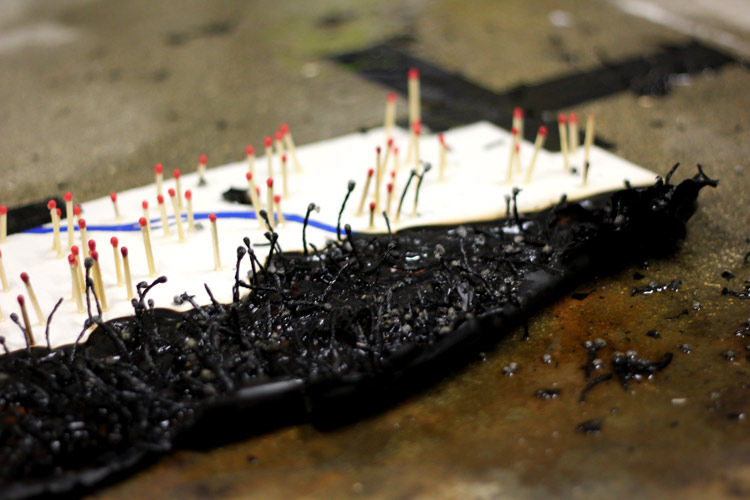
The physical construction of the piece is based on a simplified representation of Paris. At the centre lies a model of the city, while matches are placed around it to represent suburban areas. This spatial arrangement is deliberately symbolic rather than cartographic. It reduces the complexity of urban geography into a readable structure where relationships between centre and periphery become immediately visible.
Each match acts as both boundary and potential ignition point. The suburbs are not represented through architectural detail but through identical fragile elements. This uniformity emphasizes the idea of tension distributed across a system rather than localized in a single area.
The animation begins with a single match igniting. This initial flame is the starting point of a chain reaction. Fire spreads progressively from one match to another, creating a visual sequence of escalation. The movement of fire is slow at first, then accelerates as the system becomes increasingly unstable.
Eventually, the fire reaches the central model of Paris itself. The city, initially presented as separated and protected, is also consumed by the flames. This progression removes the distinction between centre and periphery, suggesting that no part of the system is isolated from the others.
The burning of the entire model is not treated as spectacle alone. It functions as a structural collapse of the representation itself. The city as a stable object disappears, replaced by a temporary event of transformation and destruction. What remains is a material residue of the process.
The visual references of the work are closely linked to historical and contemporary episodes of urban unrest in France. The animation explicitly echoes the riots of 2005 in the French suburbs, as well as more recent episodes of violence in 2023. These events revealed recurring patterns of tension between different parts of the urban territory.
Rather than illustrating specific events, the project abstracts them into a system of propagation. The fire becomes a metaphor for escalation mechanisms within urban environments, where localized incidents can extend rapidly across multiple zones.
The metaphor of matches reinforces this logic. Matches are simple objects associated with ignition, fragility, and potential danger. In this context, they also function as representations of suburban territories. Their uniform appearance suggests equality in structure but not in condition, reflecting the simplification of complex social realities into symbolic forms.
As the fire spreads, the model transitions from structured representation to unstable material. The boundaries between different areas dissolve. The central city, initially isolated in the composition, becomes part of the same process of destruction. This undermines any clear separation between centre and suburbs as distinct entities.
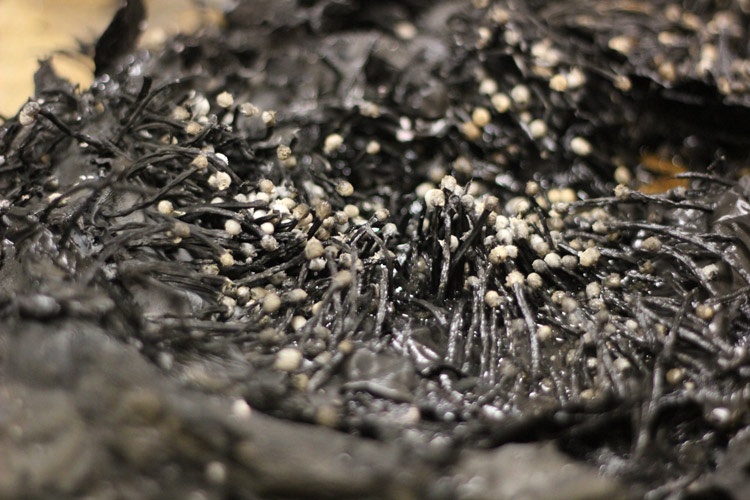
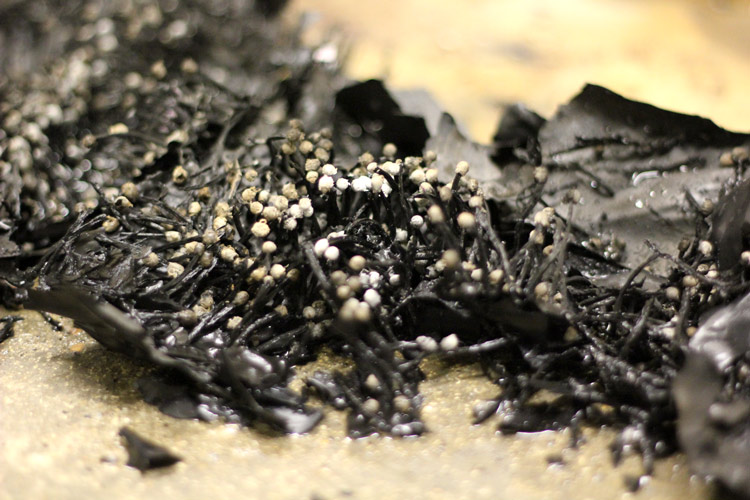
After the fire has consumed the entire model, the animation shifts to close-up views of the burnt remains. These fragments show distorted structures, blackened surfaces, and partially destroyed elements of the original model. The focus moves from the system as a whole to its material traces.
These remnants serve as a form of visual reflection. They do not reconstruct the original model but instead document its transformation. The viewer is left with fragments that suggest both the existence and disappearance of the urban structure.
A key component of the work is the use of music. The soundtrack, Magic Moments by Frank Sinatra, introduces a strong contrast with the visual destruction. The cheerful and nostalgic tone of the music creates a dissonance with the burning model, producing a tension between auditory memory and visual collapse.
This contrast is intentional. It disrupts the expectation of alignment between sound and image. Instead of reinforcing the violence of the scene, the music creates a parallel emotional layer that complicates interpretation.
The city in this work can also be understood as a system resembling a living organism. The propagation of fire resembles a pulse or biological reaction spreading through interconnected parts. In this reading, Paris and its suburbs are not separate units but components of a single structure that reacts as a whole.
“Banlieues” who plays with matches therefore operates as both a physical experiment and a symbolic reflection. It transforms a simple material setup into a visual model for thinking about urban dynamics, collective tension, and systemic fragility.
Frequently Asked Questions
What is “Banlieues” who plays with matches about?
It is an animation using a model of Paris and matches to explore urban tension and the spread of fire as a metaphor for social dynamics.
What do the matches represent?
Each match symbolizes a suburban area surrounding the central city of Paris.
What is the meaning of the fire spreading?
It represents the escalation and propagation of urban tensions across the entire urban system.
Is the work based on real events?
It references the riots of 2005 and more recent unrest in France, without depicting specific events directly.
Why is cheerful music used in the video?
Frank Sinatra’s “Magic Moments” creates a contrast that intensifies the reflection on destruction and urban tension.