
Kanos en espana / Industrial Mutation and Latin Death Iconography
“Kanos en espana” is a street art project by Alex Kanos in Spain exploring the transformation of industrial elements in a state of visual mutation. The work focuses on the tension between mechanical structures, decay, and organic transformation, where industrial forms appear to be dissolving, shifting, or evolving into unstable configurations.
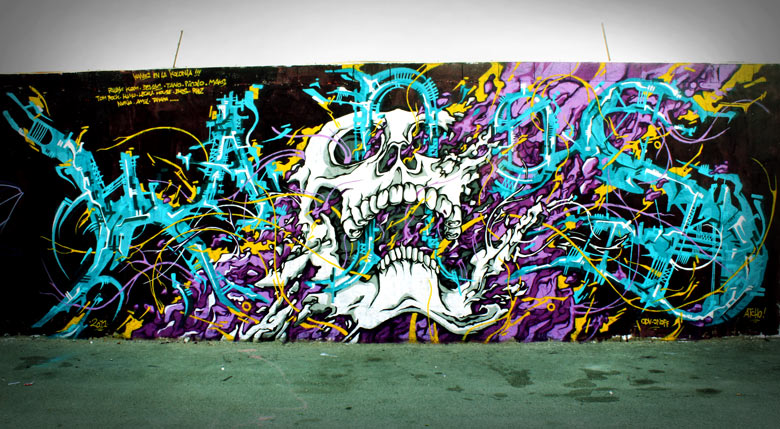
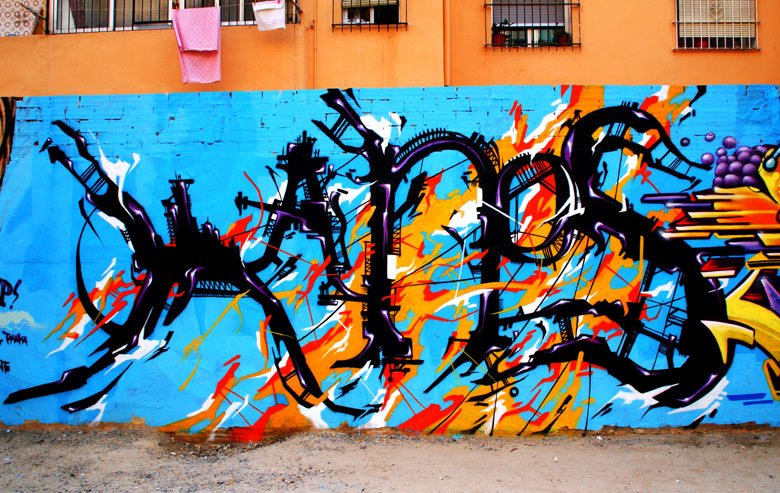
Rather than representing industry as a stable system, the artwork focuses on its instability. Pipes, mechanical forms, structural fragments and architectural references appear altered, as if they are undergoing a process of visual mutation. These elements are not depicted as functional components, but as shifting materials caught between construction and decay.
Within this industrial landscape, a central skull introduces a symbolic and cultural dimension. Inspired by Latin iconography, the skull is not used as a simple representation of death. Instead, it refers to a broader memento mori tradition, where mortality is integrated into visual culture as a reminder of impermanence, transformation and memory.
The skull acts as a structural anchor within the composition. It connects the industrial environment to a human and cultural layer, creating a dialogue between modern mechanical systems and historical symbolic references. This combination produces a tension between contemporary urban reality and ancestral visual codes.
In this work, the skull is not isolated or dominant. It is embedded within the industrial composition, partially merged with the surrounding structures. This integration reinforces the idea that death, memory and transformation are not external concepts but are already present within systems of production, construction and urban development.
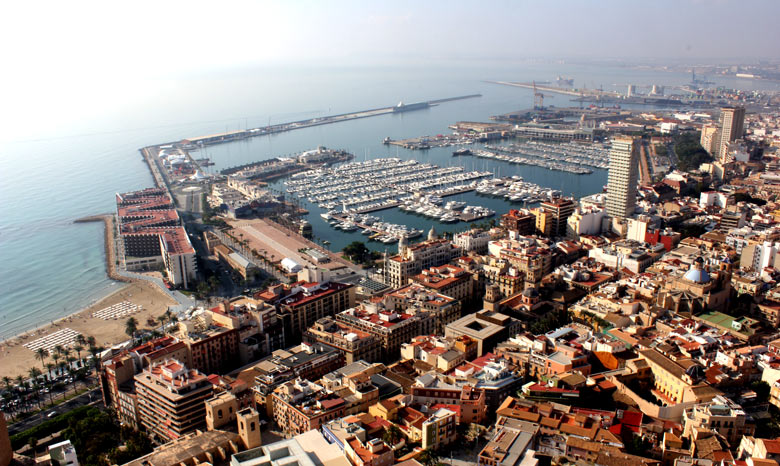
The Spanish context of the project adds an additional layer of meaning. Spain carries a strong visual heritage linked to baroque symbolism, religious imagery and Latin cultural traditions where representations of skulls and mortality are historically present. This cultural background resonates with the iconography of the work, creating a subtle connection between contemporary street art and historical visual language.
The industrial mutation present in the painting also reflects broader contemporary concerns. Modern cities are built on layers of industrial transformation, where old infrastructures are constantly replaced, repurposed or abandoned. The artwork captures this unstable condition, where material structures exist in a transitional state rather than a fixed form.
The painting process itself reinforces this concept. Acrylic paint allows for both precision and disruption, making it possible to combine controlled graphic structures with more organic or eroded surfaces. This duality reflects the tension between order and chaos, construction and dissolution.
By merging industrial forms with Latin skull symbolism, the work creates a hybrid visual system. It does not separate technology from culture, or structure from symbolism. Instead, it presents them as interconnected layers within the same visual field.
This project is part of a broader artistic research by Alex Kanos focused on industrial mutation, symbolic anatomy and urban transformation. Across different locations and interventions, these themes reappear as variations of the same conceptual framework: the idea that contemporary environments are constantly evolving systems where material, memory and symbolism coexist.
In “kanos en espana” project, the city becomes both a physical space and a conceptual structure. It is a site of transformation where industrial logic, cultural memory and symbolic imagery overlap, creating a dense visual narrative rooted in mutation and transition.
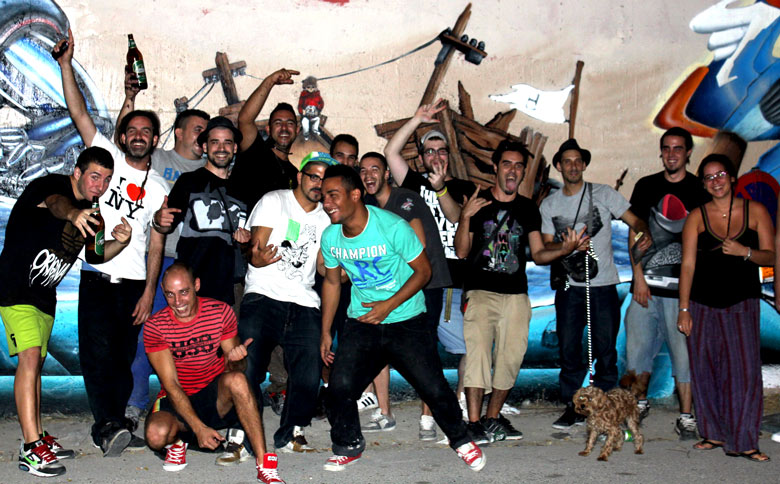
Travel in Spain / Thanks to Rudi, Nuria, Picolo, Amel, Tanaka, Tom Rock, Devas, Com1, Maks, Humo, Lechu, House, Dhes, Rhez, DjTano, Znp….
Frequently Asked Questions
What is the main concept of “kanos en espana” project in Spain?
The project explores industrial transformation and mutation combined with symbolic references to Latin cultural representations of the skull and mortality.
What does the skull represent in the artwork?
The skull refers to Latin-inspired memento mori symbolism, representing memory, mortality and cultural heritage rather than literal death.
What themes are explored in this work?
The main themes are industrial decay, transformation, mutation, and the relationship between modern structures and symbolic historical imagery.
Why are industrial elements important in this project?
Industrial structures represent systems in transition, highlighting instability, transformation and material evolution within urban environments.
Is this work purely symbolic or also contextual?
It is both symbolic and contextual, combining cultural references with industrial urban environments in Spain.