
Meeting of styles 2012 London and Brick Lane
Meeting of styles London documents my participation in the 2012 edition, one of the major international gatherings dedicated to graffiti and mural art. This invitation came after my participation in the Meeting of Styles festival in Wiesbaden, Germany, and just before I became responsible for the graphic design and visual communication of Meeting of Styles France in Perpignan for the 2012, 2013 and 2014 editions. Together, these projects represent an important period of international collaboration and artistic development.
Meeting of Styles has become one of the most influential graffiti festivals in the world by creating opportunities for artists from different countries to work together on large-scale murals while exchanging ideas, techniques and visual approaches. The London edition has long occupied a special place within this international network thanks to its vibrant graffiti scene and the work of local organizers who helped establish the event over many years.
My invitation to London was made possible thanks to Jim Vision and the End of the Line collective, whose commitment to promoting graffiti and mural painting has contributed significantly to the city’s urban art landscape. Their support not only allowed me to participate in the festival itself but also led to another opportunity to paint one of London’s best-known graffiti locations.
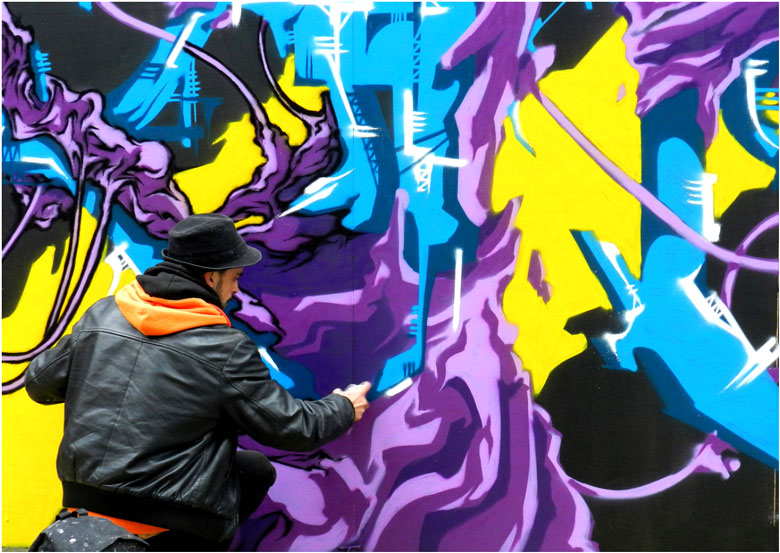
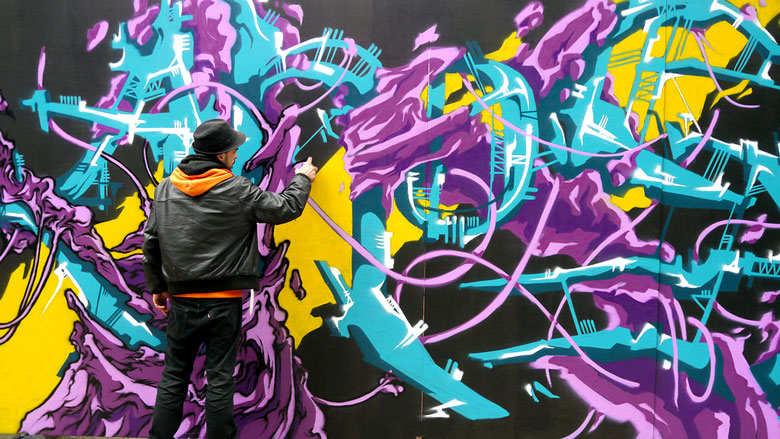
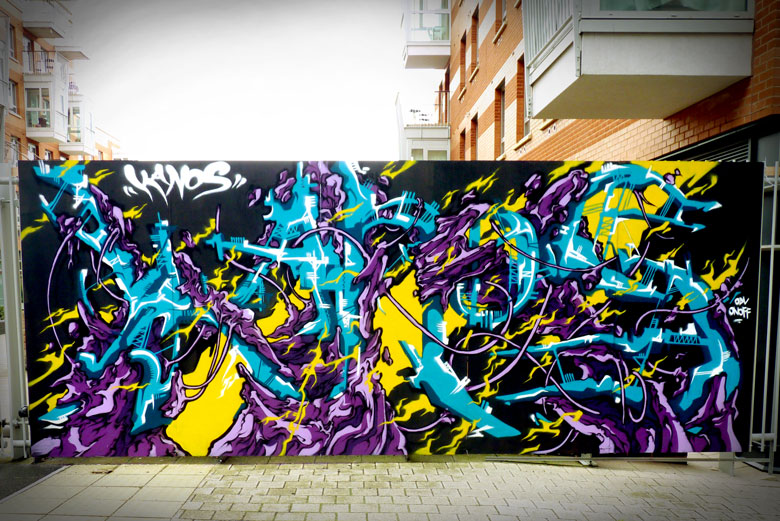
The first mural created during the festival continues a visual language that had already become central to my work. The composition is built around industrial lettering inspired by the metallic structures of factories, bridges and mechanical frameworks. Rather than drawing conventional graffiti letters, I construct typography as if each character were assembled from steel beams, industrial supports and architectural components.
These industrial structures are then covered by a second visual layer composed of organic purple forms. Instead of remaining rigid and mechanical, the letters appear to be invaded by living matter that grows over and through the industrial framework. This coexistence between mechanical order and organic transformation reflects one of the recurring themes throughout my work.
The relationship between these two visual systems is not presented as a conflict but as a continuous dialogue. Industrial structures represent construction, technology and human intervention, while the organic layer evokes nature, mutation and continuous transformation. Neither element dominates the other. Instead, both coexist to create hybrid forms that suggest cities constantly evolving under the influence of time.
This duality also echoes the changing nature of post-industrial urban environments. Former industrial districts often become spaces reclaimed by vegetation, new communities and artistic practices. Graffiti itself frequently occupies these transitional places, creating another layer within an already evolving urban landscape.
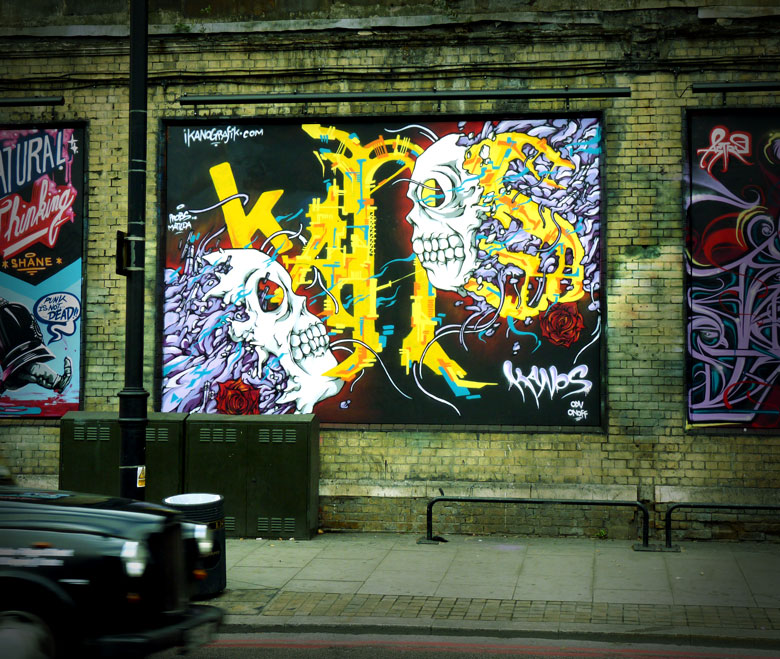
Following the Meeting of Styles event, Jim Vision gave me the opportunity to paint another mural at one of the most famous locations on Brick Lane in London. At the time, this wall consisted of large billboard-style panels measuring approximately four by three metres. Originally designed for advertising, these structures gradually became iconic painting spaces for graffiti and street artists.
Painting on these former advertising panels introduced another interesting contrast. Commercial communication gave way to artistic expression, transforming a medium intended for advertising into a platform for independent visual creation. This change of function reflects the broader ability of cities to reinterpret and reinvent their own spaces.
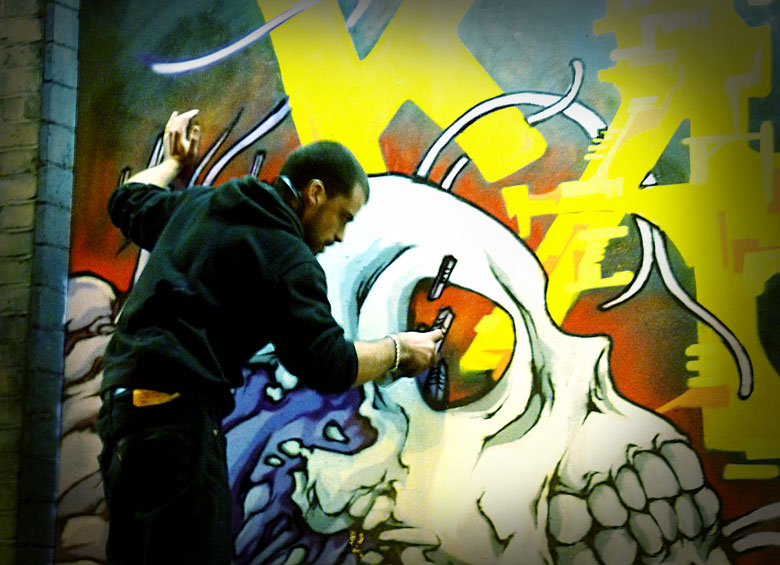
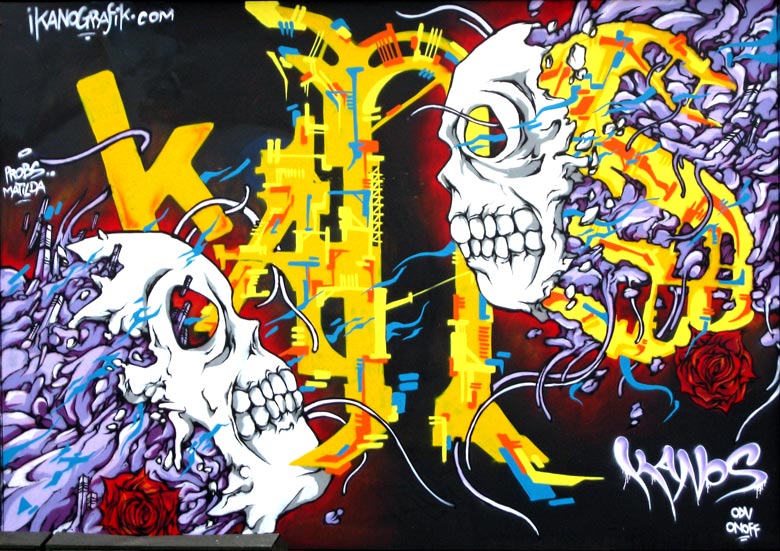
For this second mural, I chose a different visual approach while maintaining continuity with my existing work. The composition features two skull-like faces inspired by ceremonial masks commonly associated with Latin American visual traditions. Rather than presenting them as symbols of horror, the figures explore memory, identity and transformation through stylized forms.
The two faces are shown in profile, facing one another across the composition. Their mirrored positioning creates a visual dialogue between them, suggesting communication, balance or confrontation depending on the viewer’s interpretation. This symmetry establishes the overall structure of the mural.
Between these two figures, my industrial lettering appears in the background, connecting both portraits into a single composition. Instead of functioning as a foreground element, the typography becomes the structural link that unifies the mural. It acts almost like an architectural framework supporting the entire image.
Roses accompany the two faces, introducing an organic counterpoint to the skeletal imagery. Throughout art history, roses have often symbolized beauty, fragility and renewal. Their presence softens the composition while reinforcing the recurring relationship between life and decay already explored in other works from this period.
Looking back, these two London murals illustrate different aspects of the same artistic research. The first focuses on the dialogue between industrial typography and organic growth, while the second expands this language by incorporating symbolic portraiture and floral elements into the composition. Together they demonstrate the evolution of a visual vocabulary that continued to develop throughout subsequent projects.
Beyond the murals themselves, Meeting of Styles London remains an important memory because of the artists encountered, the conversations shared and the collaborative atmosphere that has always defined the festival. It reinforced the importance of international exchange within graffiti culture and contributed directly to later projects, including my work on the visual identity of Meeting of Styles France.
Pix by Myriam Preston, Street magnetic, SurreyBlonde. Thanks to Jim & Matilda for your invitation.
Frequently Asked Questions
What is Kanos Meeting of Styles 2012 London about?
The article documents my participation in Meeting of Styles London 2012 and the two murals I created during my stay.
Who invited you to paint in London?
I participated thanks to Jim Vision and the End of the Line collective, who have organized Meeting of Styles London for many years.
What is represented in the first mural?
The mural features industrial-inspired lettering covered by organic purple forms, continuing the dialogue between mechanical and organic structures.
What did you paint on Brick Lane?
I painted two skull-inspired faces influenced by Latin American ceremonial masks, connected by my industrial lettering and accompanied by two roses.
How does this project connect to your other Meeting of Styles collaborations?
It follows my participation in Wiesbaden and precedes my role as graphic design and communication director for Meeting of Styles France in 2012, 2013 and 2014.