
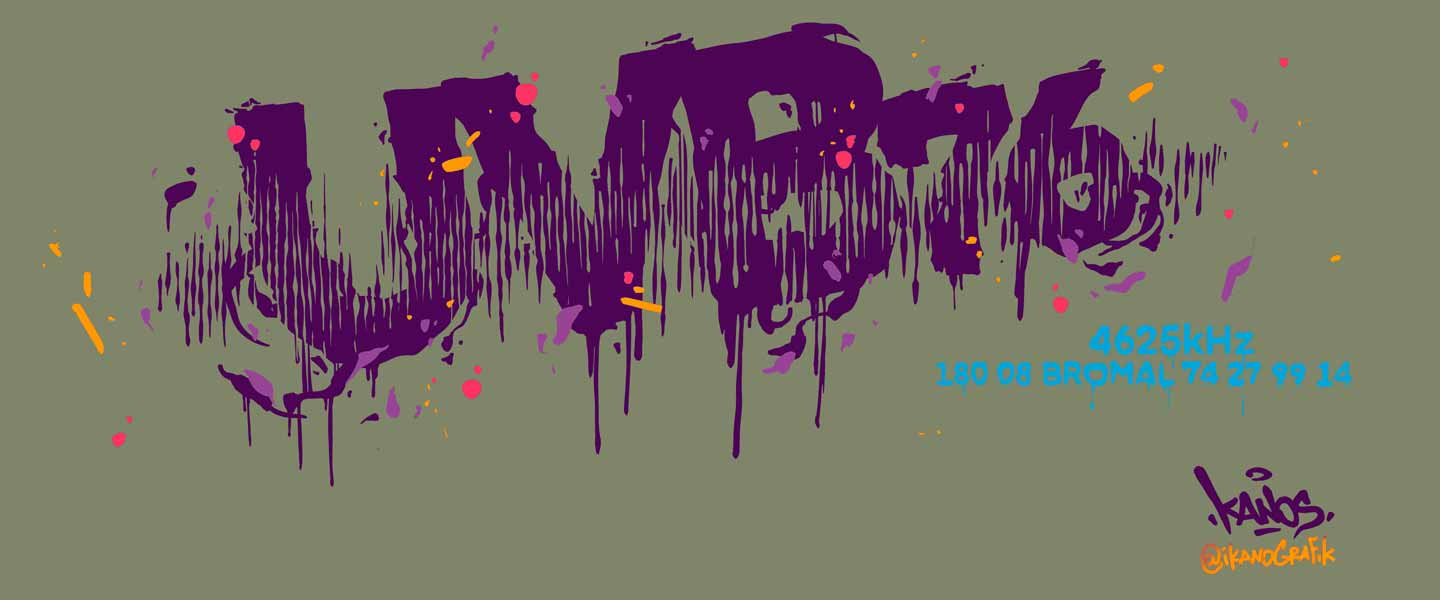
UVB76 Installation Inspired by Number Stations
UVB76 Installation at CrHOME: Transforming an Abandoned Apartment into a Post-Apocalyptic Narrative
In September 2024, I was invited by UnePhase2Styles to participate in CrHOME (Creative Reality Home), an immersive urban art exhibition organized in collaboration with Moselis in the Bellevue district of Forbach, France. Rather than exhibiting artworks inside a traditional gallery, CrHOME transformed an apartment building scheduled for demolition into a temporary artistic experience where every room became a universe of its own.
The temporary nature of the building immediately resonated with my artistic practice. Much of my work questions transformation, memory and the fragile relationship between humanity and technology. Creating inside a place destined to disappear gave the project an additional conceptual layer. Visitors were entering a space that would soon cease to exist, reinforcing the idea that cities, like civilizations, are constantly evolving. Instead of creating a conventional mural, I wanted to build an environment capable of slowing visitors down.
My objective was not simply to produce an image, but to immerse people inside a fictional future that felt strangely believable. Every visual element, every sound and every symbol contributed to the same narrative. The project eventually became UVB76, a cyberpunk installation inspired by one of the greatest unsolved mysteries of modern radio communications.
What is UVB-76?
The title of the installation refers to UVB-76, perhaps the most famous of the so-called Number Stations. These mysterious shortwave radio stations have fascinated researchers, amateur radio enthusiasts and science-fiction fans for decades. Unlike traditional radio broadcasts, Number Stations do not transmit music, news or conversations. Instead, they broadcast repetitive sounds, coded messages or sequences of numbers, often read by synthetic or anonymous voices in different languages. Many of these transmissions have continued uninterrupted for decades without any official explanation.
Among them, UVB-76 occupies a unique place. Nicknamed “The Buzzer”, the station continuously broadcasts a monotonous buzzing sound interrupted only occasionally by coded voice messages. Since the late Cold War, thousands of radio enthusiasts around the world have attempted to understand its purpose. Despite numerous theories, no government has ever publicly confirmed its exact function.
Some researchers believe these broadcasts are linked to military communications. Others suggest they could serve as emergency transmission systems or encrypted communication channels capable of functioning even if modern digital infrastructures were destroyed. None of these explanations has been officially confirmed, which is precisely what continues to fuel the mystery. For an artist working with themes of uncertainty, technological evolution and speculative futures, UVB-76 immediately became much more than a radio station. It became the perfect metaphor for a civilization preparing for an event that may never happen.
The Fascination of Number Stations
What makes Number Stations so captivating is not only their secrecy but also their persistence. For more than half a century, they have continued to broadcast regardless of political changes, technological revolutions or the disappearance of many Cold War institutions. While humanity has transitioned from analogue communication to satellites, fiber optics and global internet networks, these enigmatic signals continue to travel across the atmosphere using technology that appears almost obsolete.
This contradiction fascinated me. In an era dominated by artificial intelligence, instant messaging and cloud computing, these anonymous radio frequencies remain strangely alive. They remind us that sophisticated technologies are not always the most resilient.
If every satellite disappeared tomorrow… If every data center stopped functioning… If global communication networks collapsed… Simple high-frequency radio waves could once again become one of the only ways to communicate across thousands of kilometers. This possibility belongs somewhere between reality and science fiction, and it became the conceptual foundation of my installation.
Imagining a World After the Collapse
Rather than illustrating the Cold War itself, I wanted to imagine what might exist after it. What would remain if humanity experienced a global technological collapse? What knowledge would survive? How would we communicate? Would machines disappear, or would they become even more integrated into our lives? These questions led me toward a fictional post-apocalyptic universe where fragments of today’s technology coexist with the ruins of industrial civilization. The apartment offered the ideal setting for this narrative.
Unlike a museum or gallery, an abandoned apartment still carries traces of everyday life. Doors, windows and empty walls remind visitors that people once lived there. This familiarity makes the transition toward fiction even more disturbing. Instead of entering an exhibition space, visitors enter what could almost be someone’s home after an undefined catastrophe. The installation therefore relies on suggestion rather than spectacle.
Nothing explicitly explains what happened. No date is given. No war is shown. Instead, visitors are invited to reconstruct the story themselves through visual clues, symbols and atmosphere. This open narrative has always been central to my work. Rather than imposing a single interpretation, I prefer creating compositions where every viewer can build their own reading according to their personal experiences and imagination.
CrHOME as the Perfect Environment
The CrHOME exhibition created an exceptional context for this approach. Every apartment hosted a different artist, each proposing their own universe inside the existing architecture. Walking through the building became a journey between radically different visual languages. Within this collective experience, I wanted my apartment to function almost like a pause.
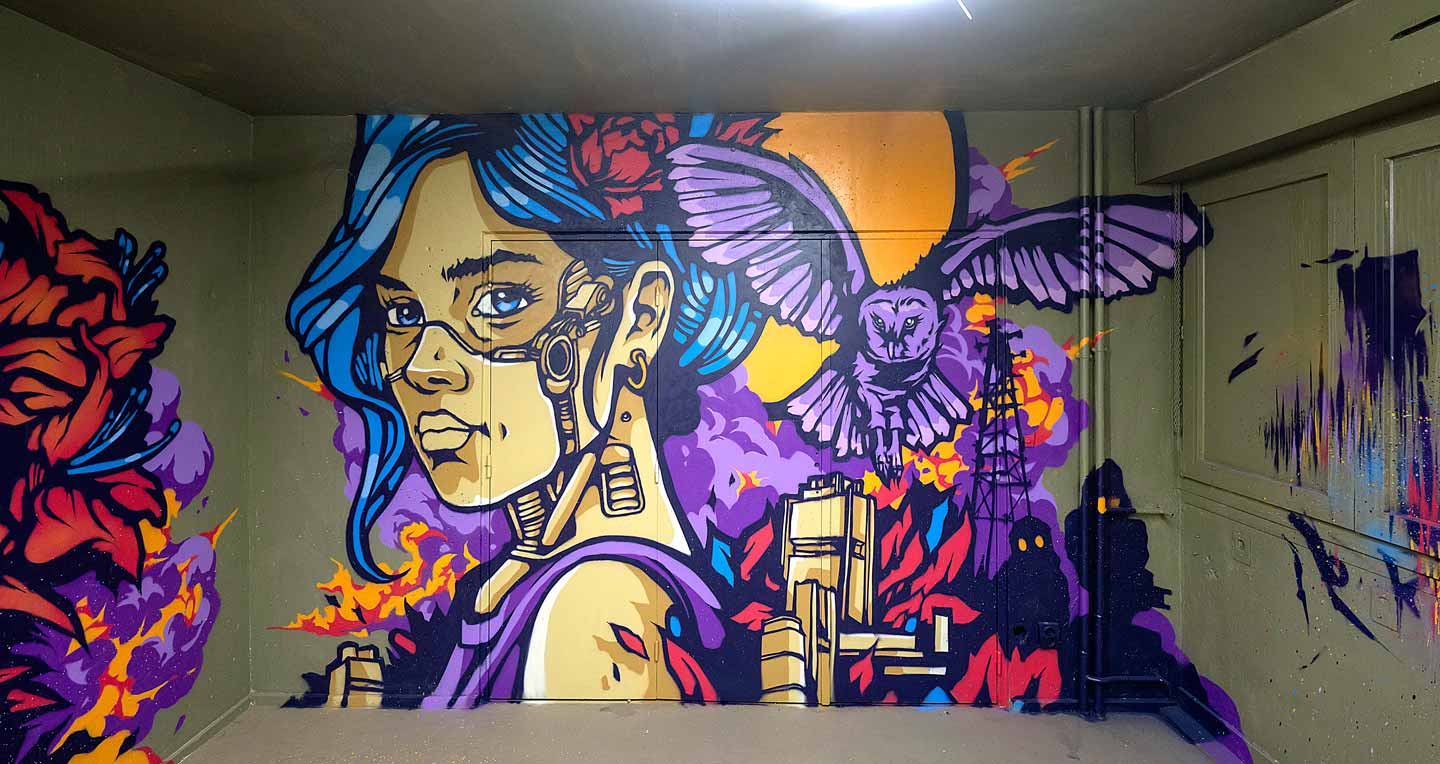
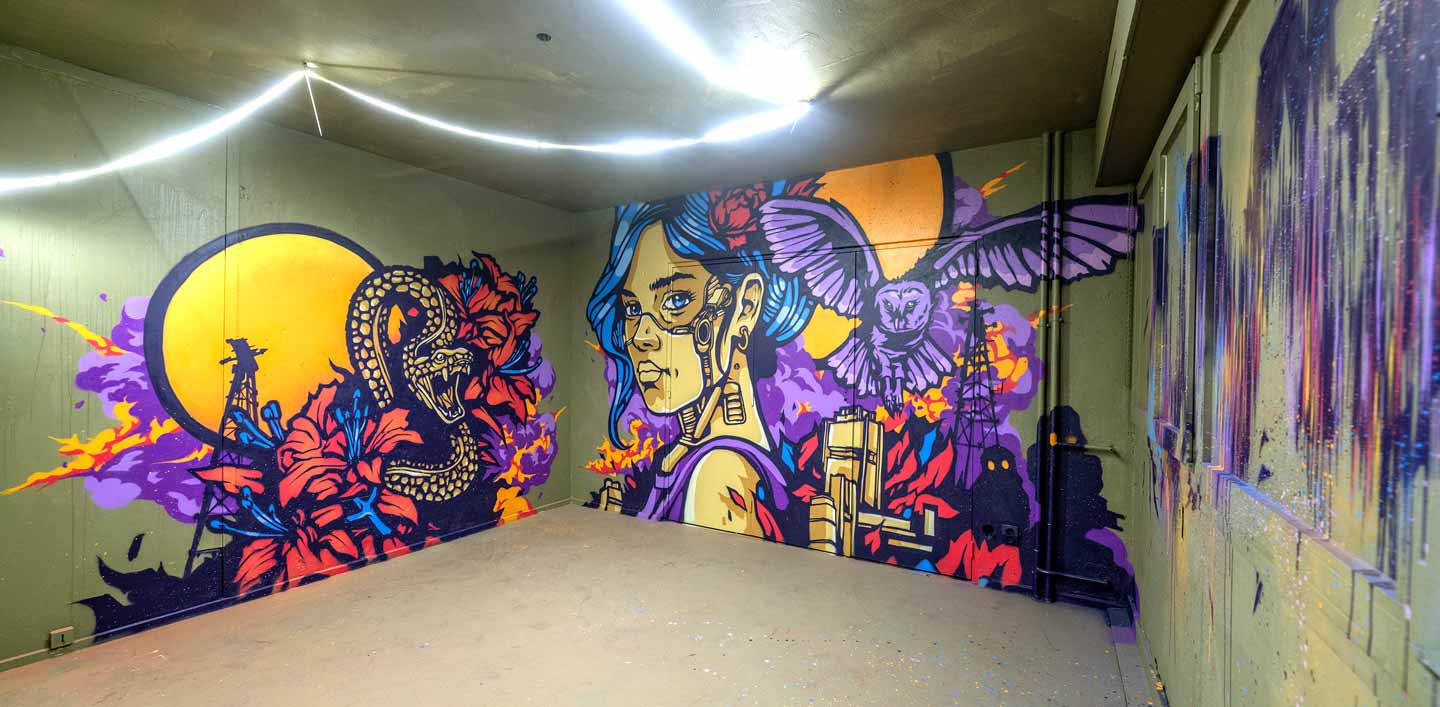
The visitor first encounters silence, then increasingly unsettling sounds begin to emerge. A subtle lighting system guides the eye through the room while revealing the mural little by little. At the end of the visual journey, a television screen continuously broadcasts a specially created video, extending the narrative beyond the painted walls.
The television itself remains physically inaccessible, positioned behind a partition for safety reasons. This deliberate separation reinforces the sensation that the viewer is observing fragments of another reality without ever fully entering it. Around the screen, damaged architectural elements, pipes and debris subtly reinforce the impression of a civilization attempting to survive within its own ruins. Rather than functioning as decorative accessories, these elements contribute to the overall atmosphere. Together with the mural, they transform the apartment into a suspended moment somewhere between memory, anticipation and speculation. The visitor is not asked to admire a painting. The visitor is invited to enter a question.
The Cyberpunk Survivor
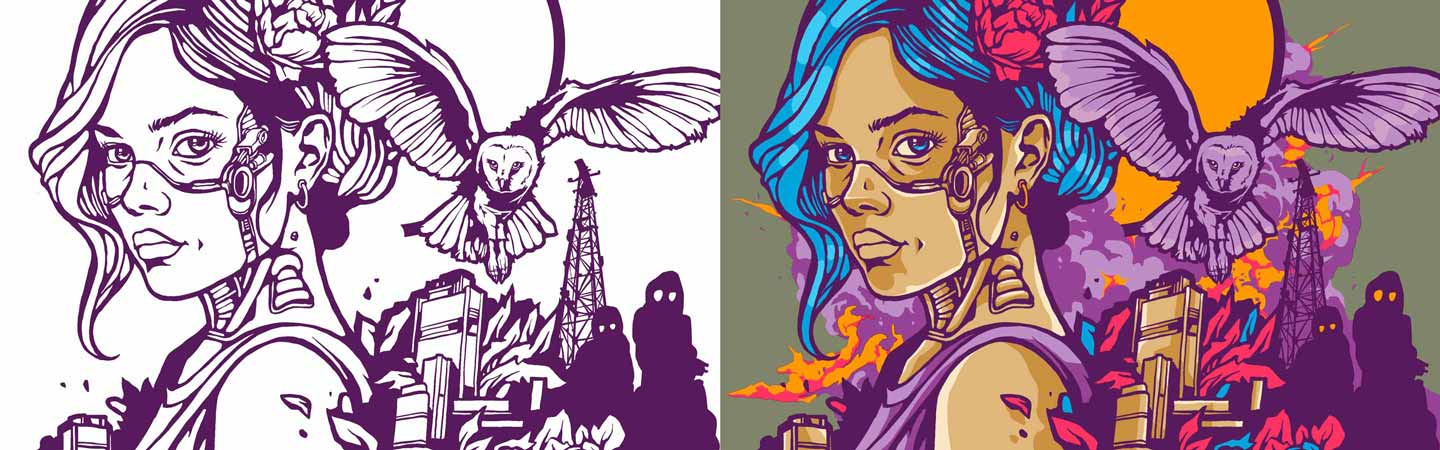
At the center of the installation stands a female character whose appearance immediately establishes the narrative. She is neither entirely human nor entirely machine. Mechanical components integrated into her face suggest a body that has adapted rather than been replaced, reflecting one of the recurring themes throughout my work: the coexistence of humanity and technology.
I chose to represent a woman because feminine figures have long occupied a central place in my visual language. Influenced by Art Nouveau, particularly the work of Alphonse Mucha, I often use female characters as symbolic rather than narrative figures. They are not portraits of specific individuals but archetypes carrying broader ideas about transformation, resilience and identity.
In UVB76, this character becomes a survivor. Nothing explicitly states who she is or what she has experienced. Her expression remains calm and determined, allowing viewers to imagine their own story. She could be one of the last witnesses of a collapsed civilization or the first inhabitant of a world rebuilt after disaster.
Unlike many cyberpunk representations that emphasize aggressive technology or dystopian violence, my intention was different. The mechanical elements do not erase her humanity. They extend it. They suggest adaptation rather than domination, illustrating how technology might become inseparable from human existence in an uncertain future.
The character does not confront the viewer directly. Her gaze is directed beyond the room, as though focused on something outside our field of vision. This simple gesture creates tension and invites questions: What is she looking at? What happened beyond the walls? Has the catastrophe already occurred, or is it still to come? Rather than providing answers, the mural leaves these possibilities open.
The Owl of Minerva
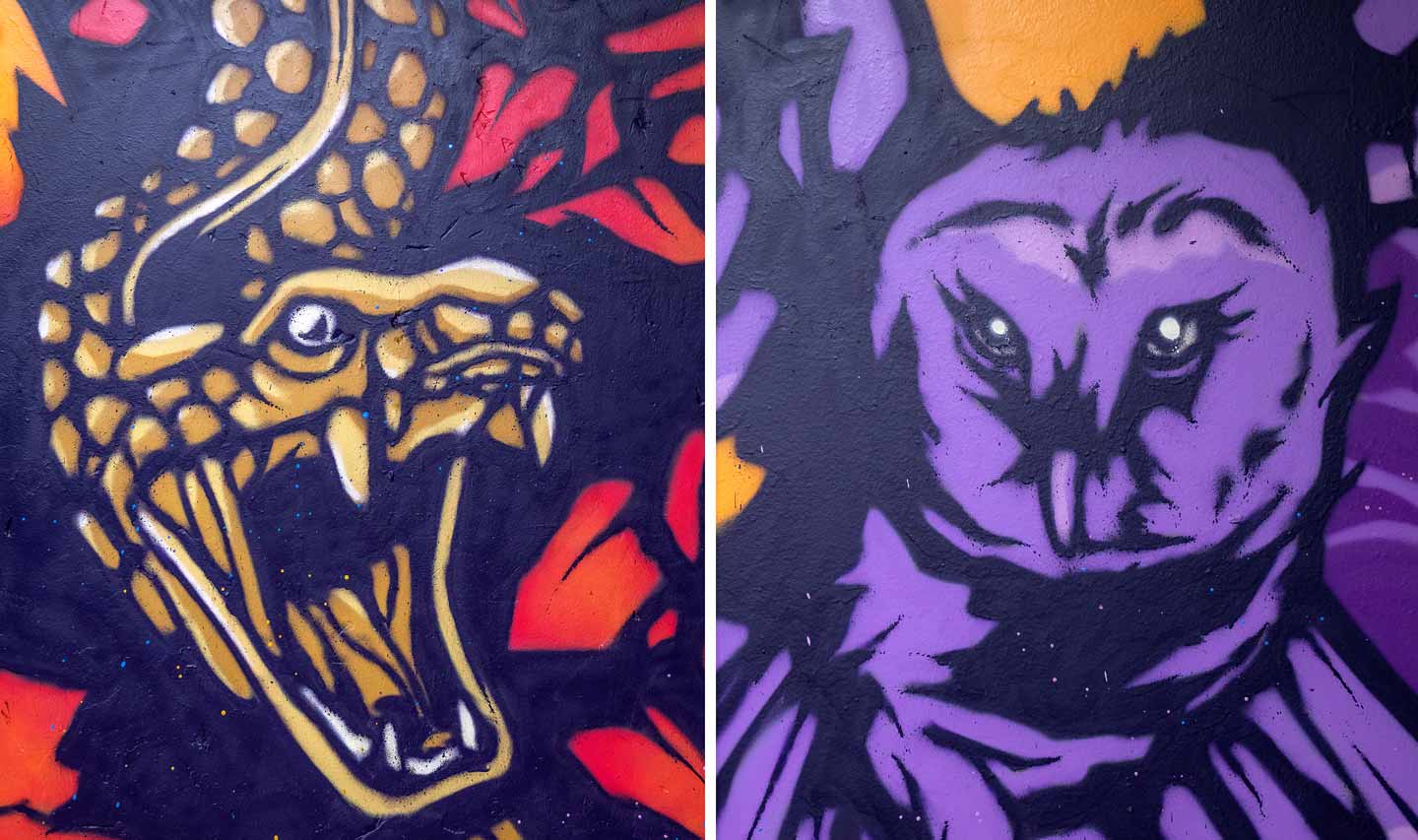
Flying beside the central figure is an owl, one of the oldest symbols associated with wisdom and knowledge. In Roman mythology, the owl accompanies Minerva, goddess of wisdom, strategy and craft. Beyond mythology, the owl has also become a philosophical symbol through the writings of Georg Wilhelm Friedrich Hegel, who famously observed that “the Owl of Minerva spreads its wings only with the falling of dusk.”
This idea has always fascinated me. Knowledge rarely appears while events are unfolding. We usually understand history only once it has already happened. We analyse wars after they have ended. We recognise mistakes once they have already produced consequences. We often discover the meaning of events only when the sequence is complete. Within UVB76, the owl represents this delayed understanding.
It takes flight after the disaster rather than before it. It reminds us that humanity frequently reacts only when it is already too late. Placed beside the cyberpunk survivor, the owl becomes more than a mythological reference. It acts as a silent witness observing the collapse of a civilization while simultaneously suggesting that knowledge may still survive. Even after destruction, understanding remains possible.
The Serpent: Poison or Cure?
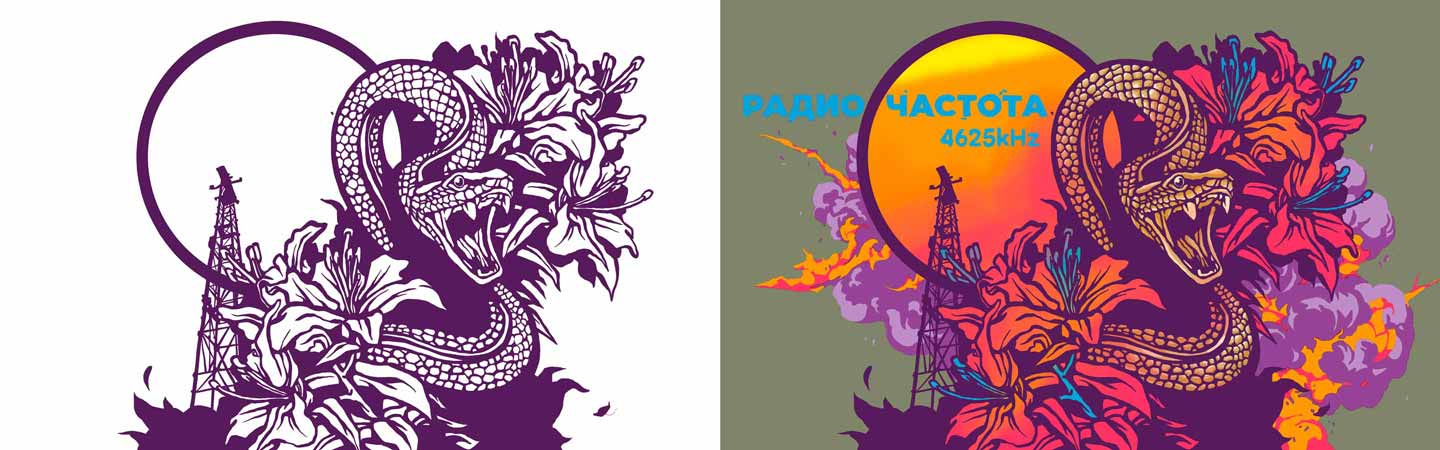
On the opposite wall appears another symbolic figure: a large serpent emerging among peonies beneath a glowing sun. Throughout human history, snakes have carried contradictory meanings. They represent danger, death and poison, yet they also symbolize healing, renewal and transformation. Medical emblems around the world still use the serpent as a symbol of knowledge and medicine. This duality perfectly matched the central idea behind the project. Technology itself functions in much the same way.
It has the capacity to improve lives, cure diseases and connect humanity across continents. At the same time, it can accelerate conflict, surveillance and destruction. Like the serpent, technology is neither inherently good nor inherently evil. Its consequences depend entirely on how we choose to use it. The snake therefore acts as a visual counterpart to the central character. Together, they represent two possible futures. One embodies adaptation. The other embodies choice.
The visitor moves physically between these two symbols while exploring the room, becoming part of the dialogue unfolding across the walls.
Creating Atmosphere Through Sound
Although mural painting forms the visual core of UVB76, sound plays an equally important role in shaping the experience. Rather than presenting the artwork in silence, I wanted visitors to enter an environment where audio would gradually influence their perception of the space. A dark, atmospheric soundtrack continuously filled the apartment. Slow drones and deep textures established a feeling of uncertainty without relying on sudden effects or obvious dramatic cues. The goal was not to frighten visitors but to encourage them to slow down and remain present inside the room.
Mixed into this soundtrack were recordings inspired by real Number Stations from different parts of the world. Fragments of coded transmissions. Anonymous voices. Foreign languages. Shortwave interference. Static. Mechanical buzzing.
Most visitors could not understand what they were hearing, and that was precisely the point. Communication existed, but meaning remained inaccessible. The incomprehensible nature of these broadcasts reinforced the mystery surrounding UVB-76 while suggesting a world where information continues to circulate even after its original context has disappeared.
The television positioned beyond the partition extended this atmosphere further. It continuously displayed a specially created video that complemented the mural without explaining it. Because visitors could not physically access the screen, the image remained slightly distant, almost like a transmission received from another place or another time. Together, painting, sound, light and moving image formed a single environment rather than separate artworks.
Science Fiction as a Tool for Reflection
Although UVB76 borrows many visual codes from cyberpunk culture, it should not be understood simply as a science-fiction illustration. Science fiction has always served another purpose. It allows us to imagine futures that encourage reflection on the present. Many of today’s technologies once belonged entirely to speculative fiction. Artificial intelligence, autonomous machines, cybernetic augmentation and global communication networks were all imagined by writers and filmmakers long before becoming everyday realities.
My references naturally include works such as Blade Runner, Ghost in the Shell, Akira, Mad Max and the original Fallout games. These works are not important because they predict the future accurately, but because they ask enduring questions about identity, technology, society and survival. These same questions remain at the heart of UVB76. The installation does not predict nuclear war. It does not claim to know humanity’s future. Instead, it asks a simpler question:
Will we collectively address the challenges that threaten us, or will history continue repeating the same cycles under different technological forms?
For me, this remains one of the essential functions of contemporary art. Not to provide answers, but to create spaces where uncertainty, imagination and critical reflection can coexist.
Conclusion
Ultimately, UVB76 is less about a fictional apocalypse than about the choices we make today. The installation borrows imagery from cyberpunk culture, Cold War history and post-apocalyptic fiction, but its purpose is not to predict the future. Instead, it uses speculative storytelling to encourage reflection on the direction of our own society. Technology continues to evolve at an unprecedented pace, reshaping the way we communicate, work, create and even perceive ourselves. The question is no longer whether these transformations will happen, but how we choose to live alongside them.
The mysterious broadcasts of UVB-76 became the perfect starting point for this reflection. Their anonymous signals, transmitted for decades without public explanation, symbolize the uncertainty that often accompanies technological progress. They remind us that knowledge is never complete and that many systems surrounding us remain invisible until circumstances force us to confront them.
The apartment at CrHOME provided the ideal setting for this narrative. A place built for everyday life became a temporary environment dedicated to imagination, speculation and contemplation before disappearing forever. Like the building itself, the installation only existed for a limited time, reinforcing the ephemeral nature of street art and contemporary urban interventions.
Through mural painting, sound design, lighting and environmental storytelling, UVB76 invites visitors to pause rather than simply observe. The cyberpunk survivor, the Owl of Minerva and the serpent each represent different aspects of humanity’s relationship with knowledge, technology and responsibility. Together they form an open narrative that encourages multiple interpretations instead of imposing a single message.
Science fiction has always been one of the most powerful tools for questioning the present. It allows us to imagine futures that may never happen while revealing the consequences of decisions we are making today. Whether inspired by mysterious radio transmissions, mythology or cyberpunk aesthetics, UVB76 ultimately asks a simple question:
Can humanity learn from its own history before history repeats itself once again?
Frequently Asked Questions
What is UVB76?
UVB76 is an immersive cyberpunk installation created by French street artist Alex Kanos for the CrHOME exhibition in Forbach, France. The project combines mural painting, sound design and environmental storytelling.
What inspired the project?
The installation is inspired by UVB-76, one of the world’s most famous Number Stations. These mysterious shortwave radio transmissions have fascinated researchers and radio enthusiasts since the Cold War due to their unknown purpose and continuous broadcasts.
Where was UVB76 exhibited?
The installation was created for CrHOME (Creative Reality Home), an urban art exhibition organized by Une Phase 2 Styles and Moselis inside an apartment building scheduled for demolition in the Bellevue district of Forbach.
Why use cyberpunk imagery?
Cyberpunk offers a visual language capable of exploring the relationship between humanity and technology. Rather than presenting technology as inherently positive or negative, the installation reflects on how technological evolution shapes identity, society and the future.
What do the owl and the snake symbolize?
The Owl of Minerva represents wisdom and understanding that emerge after events have unfolded. The serpent symbolizes duality, capable of representing both destruction and healing, much like technology itself.