
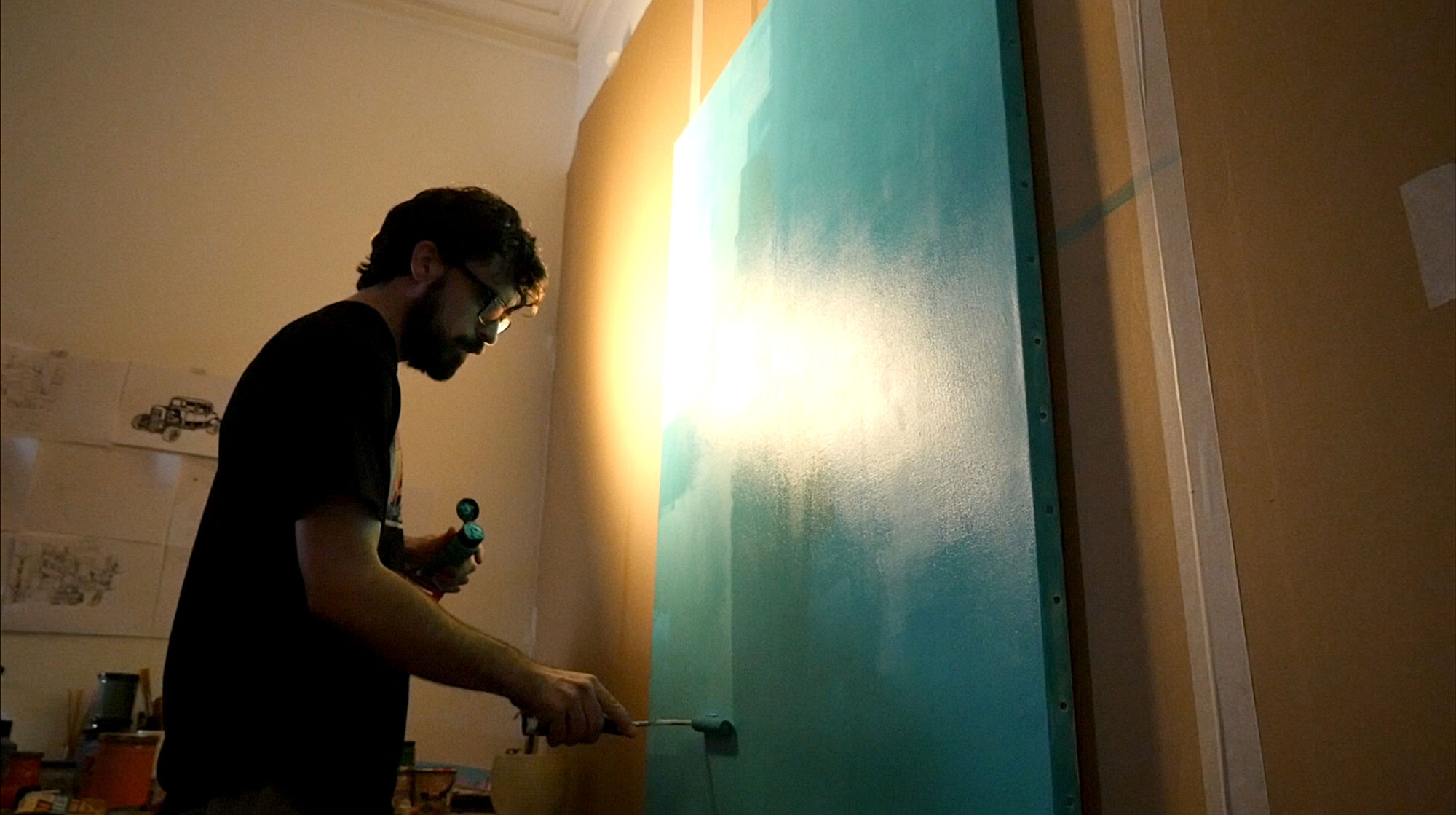
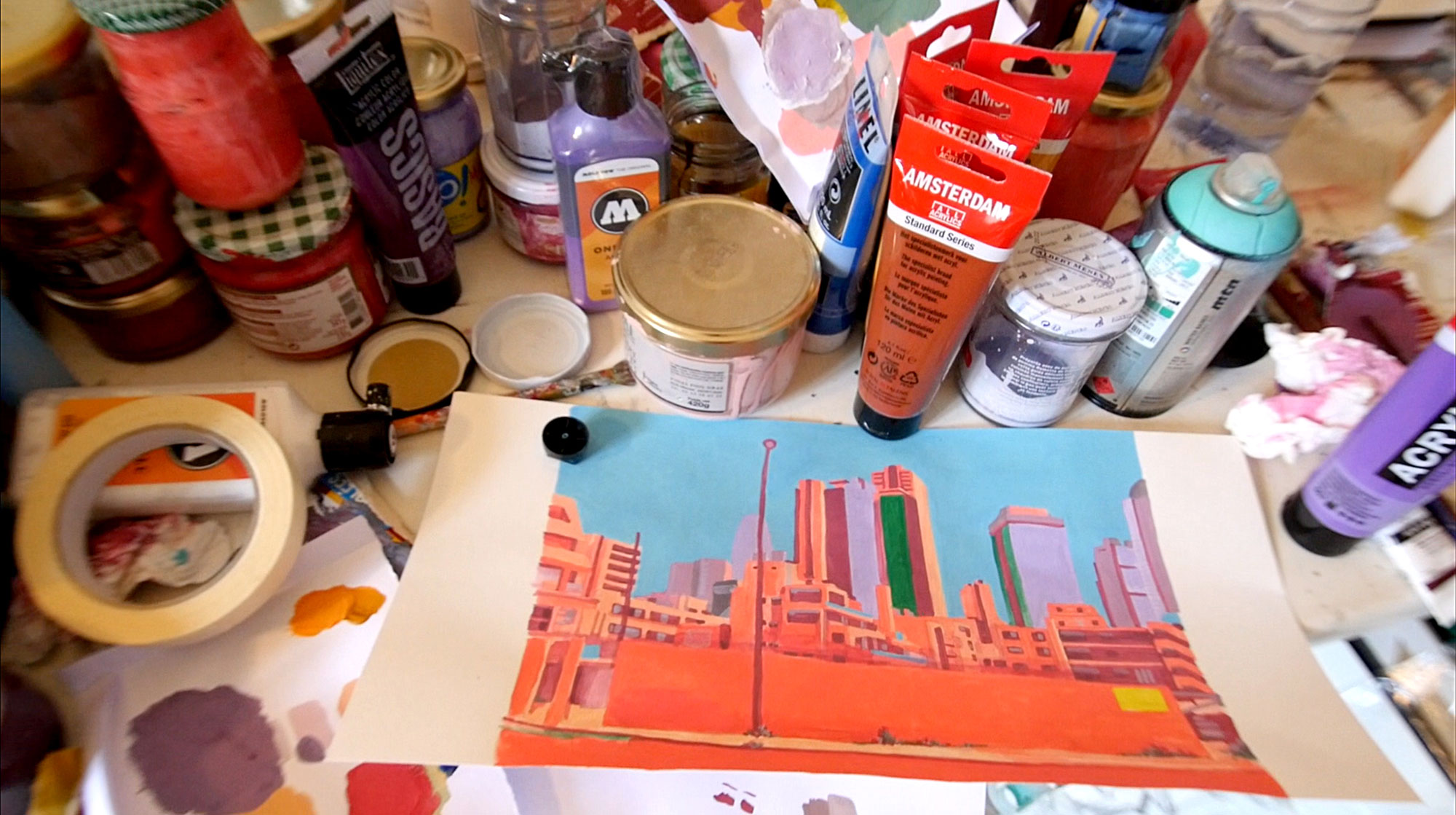
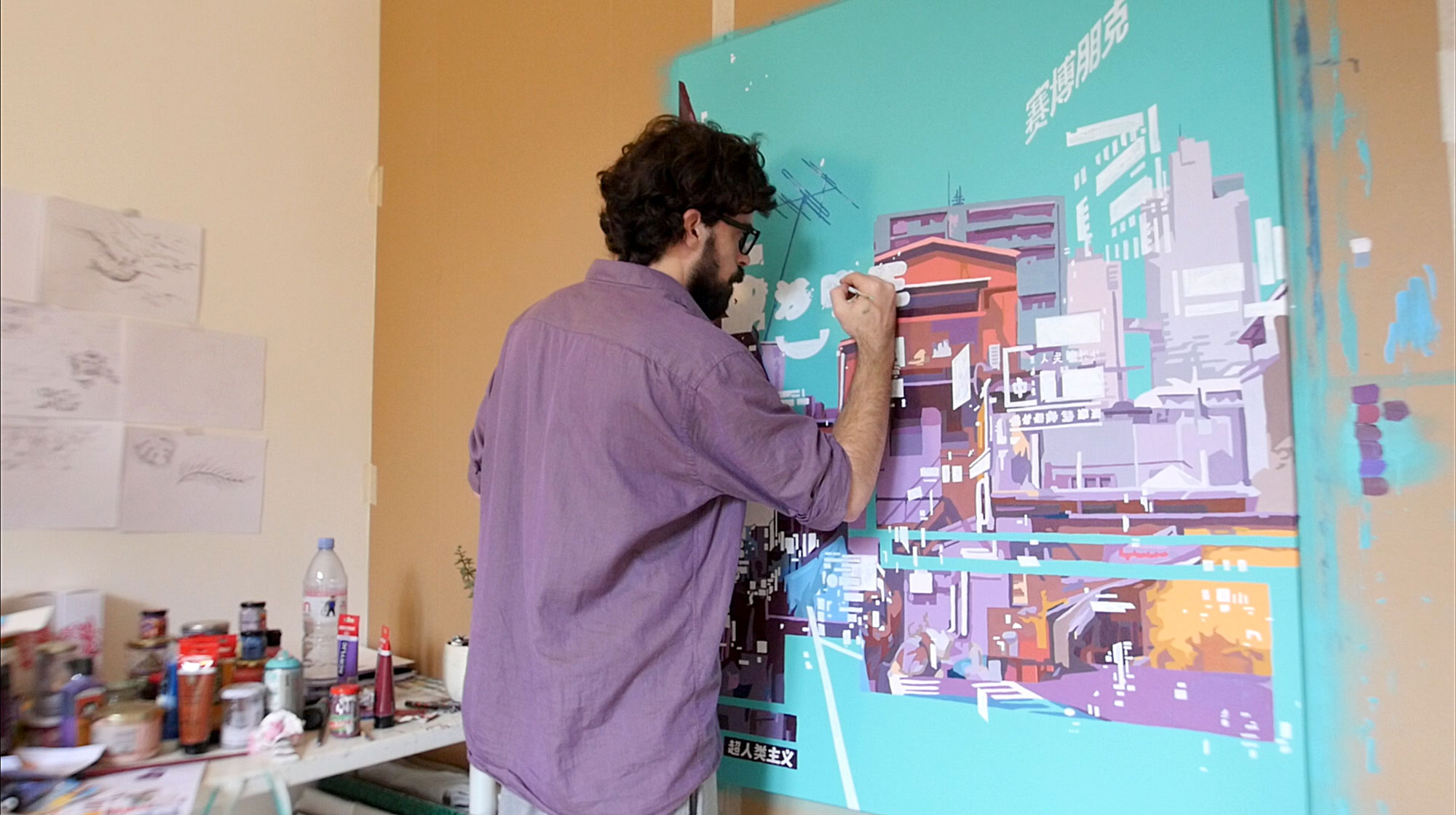
ENDLESS CIRCLES canvas about neon city and empty center
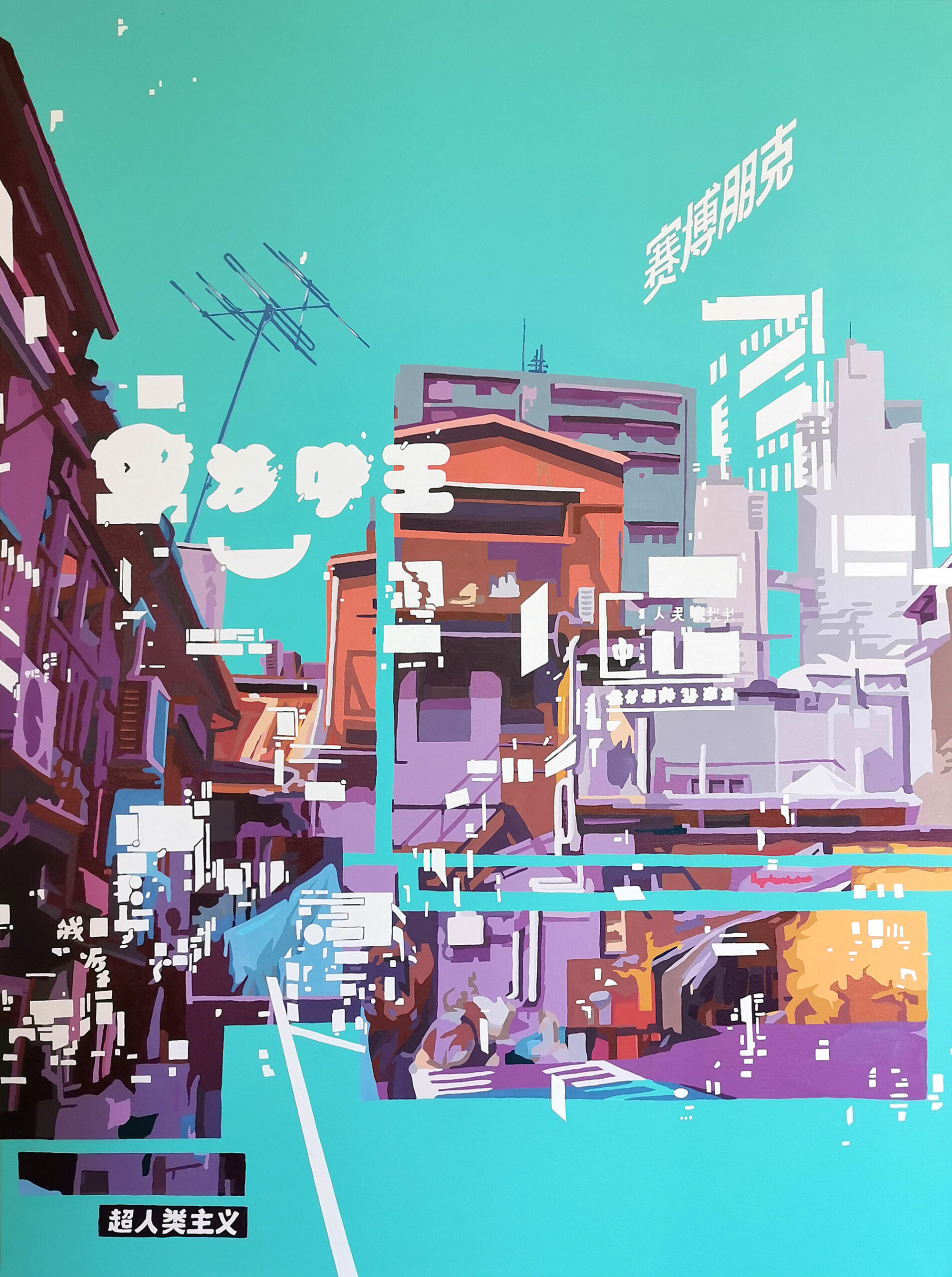
During my graffiti travel in Hong-Kong i was inspired by plenty of neon signs in the Streets. I try to recompose streets with plenty of signs and building and I continue to explore how these visual elements shape our perception of modern cities.
The artwork Endless Circle is built around a reflection on urban perception, inspired by Roland Barthes’ analysis of Tokyo and its paradoxical structure. The idea of a city without a visible center becomes a conceptual foundation for exploring how contemporary urban environments function as systems of signs rather than fixed physical structures.
In many modern megacities, especially in Asia, the urban experience is defined less by architectural landmarks and more by constant flows of information, signage and visual stimuli. Neon lights, advertising panels, digital screens and overlapping symbols create a dense visual field that reshapes how space is understood and navigated.
The reference to Hong Kong and Tokyo is central to the development of this work. These cities are characterized by extreme verticality, layered infrastructures and a continuous saturation of visual information. This environment became a key source of inspiration for reconstructing fragmented urban compositions.
Endless Circle translates these observations into a visual structure based on repetition, fragmentation and accumulation. Instead of representing a single coherent cityscape, the work reconstructs urban fragments as if they were constantly circulating around an invisible center.
The influence of Roland Barthes introduces a theoretical dimension to the project. His interpretation of Tokyo as a city organized around an “empty center” becomes a metaphor for contemporary urban life, where meaning is no longer concentrated but distributed across multiple layers of signs and references.
In the video work associated with this piece, additional visual material is integrated, including fragments of urban signage and architectural details. These elements are partially obscured by white blocks, creating a tension between visibility and erasure. This process reveals the overwhelming density of information present in modern cities.
The use of white squares functions as both a compositional tool and a conceptual device. It highlights the act of perception itself, suggesting that urban reality is always filtered, selected and reconstructed by the viewer. What remains visible is only a fraction of the total visual environment.
The soundtrack inspired by Ghost in the Shell reinforces the cybernetic atmosphere of the work. The music introduces a futuristic dimension that connects human perception with technological environments. It suggests a world where physical cities and digital systems increasingly overlap.
Endless Circle can be understood as a reflection on the future of urban space. As cities evolve, the distinction between physical architecture and informational layers becomes increasingly blurred. Signs, data and digital interfaces become as important as buildings themselves.
The circular structure implied by the title reflects the continuous movement of urban experience. Rather than progressing toward a fixed destination, perception loops through layers of information, constantly reorganizing meaning without reaching a final center.
Ultimately, Endless Circle explores the relationship between cities, signs and perception. It connects theoretical reflection, travel experience and visual experimentation to construct a fragmented vision of contemporary urban life, where meaning is always in motion and never fully fixed.
”… conforming to Western philosophy, which regards each center as the seat of all truth, our town centers are always full. They are places where the values of civilization are collected and condensed : values of spirituality (with churches), power (with offices), money (with banks), goods (with department stores) and words (with the ‘agora’: cafes and walks).
Going downtown means encountering social ‘truth’, taking part in the sublime richness of ‘reality’. The city I’m referring to (Tokyo) presents this amazing paradox : it does have a center, but this center is empty. The whole city revolves around a place that is both forbidden and indifferent, an abode masked by vegetation, protected by moats, inhabited by an Emporer whom no one ever sees : literally, no one knows who does ever see him …
Its center is no more than an evaporated ideal whose existence is not meant to radiate any kind of power, but to offer its own empty center to all urban movement as a form of support, by forcing perpetual traffic detours. Thus, it appears as an image that unfurls again and again in endless circles, around an empty core … ” Roland Barthes
Frequently Asked Questions
What is Endless Circle?
Endless Circle is an artwork by Alex Kanos inspired by urban theory, Tokyo, Hong Kong and cyberpunk aesthetics.
What inspired this work?
The piece is inspired by Roland Barthes’ writing on Tokyo, neon cities in Asia and the visual density of urban environments.
What themes are explored?
The artwork explores urban perception, signs in cities, cyberpunk culture and the idea of a city without a central point.
What is the role of neon signs in the artwork?
Neon signs represent the overload of visual information in modern cities and how urban space is structured through symbols.
Is this work connected to video or sound?
Yes, it includes video elements and a soundtrack inspired by Ghost in the Shell, reinforcing its cyberpunk atmosphere.