OPHELIA BW Print / Cyberpunk Mural Art
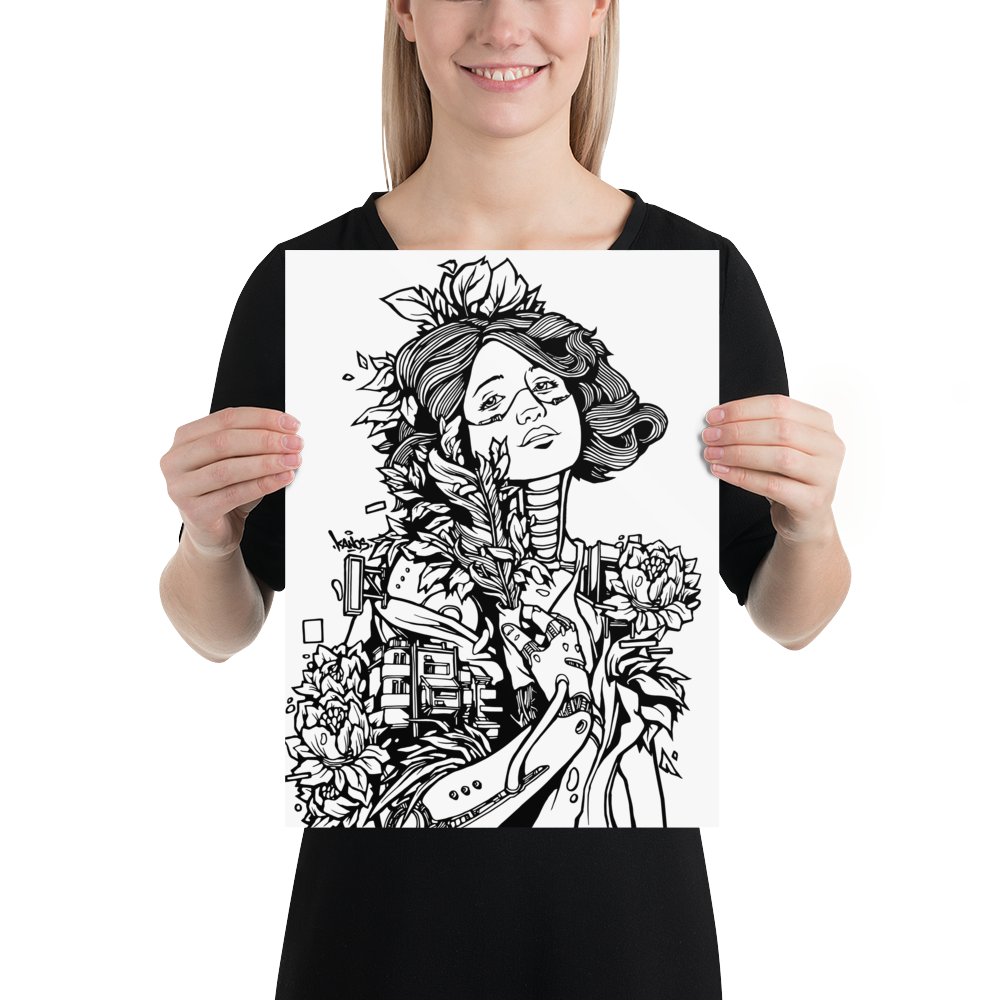
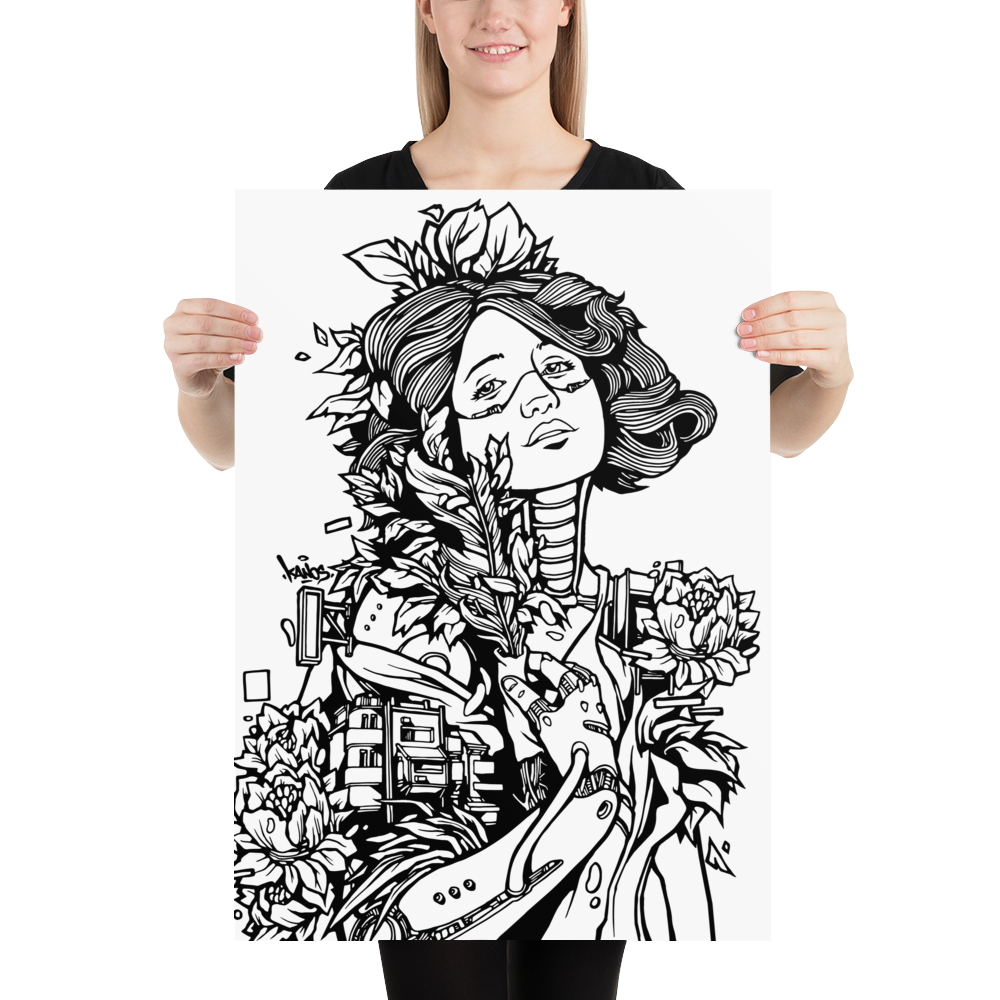
Ophelia Bw Print is based on a large-scale mural created during the 2024 edition of La Karrière, an open-air street art event held in a former Comblanchien limestone quarry in Villars-Fontaine, Burgundy. The unique geological and architectural environment of the site plays a fundamental role in the reading of the artwork, transforming it into an immersive visual experience embedded in the landscape itself. Unlike traditional urban murals, this work is painted on monumental natural stone walls. The quarry context introduces a dialogue between industrial extraction history, natural geology, and contemporary artistic intervention.
A Monumental Mural Created in a Stone Quarry
The central figure, Ophelia, is depicted as a woman intertwined with mechanical systems. Her body integrates organic forms and technological structures, creating a hybrid identity situated between human presence and engineered extension. Rather than presenting technology as external or intrusive, the work explores it as an integrated system that reshapes perception, movement and identity. This hybridization is a continuation of a recurring theme in my practice: the gradual fusion between biological structures and mechanical environments.
The Feather as a Symbol of Wisdom
A key symbolic element in the composition is the feather, held delicately by Ophelia. This motif represents wisdom, memory and consciousness. The feather introduces a counterbalance to the mechanical density of the composition. It remains light, fragile and organic, suggesting that knowledge is not only structured or technical, but also intuitive and sensitive. It acts as a focal point within the visual complexity of the mural, guiding interpretation without imposing meaning.
A Visual Labyrinth Between Past and Future
The composition is constructed as a visual labyrinth where multiple temporalities coexist. Influences from 19th-century decorative arts, particularly Art Nouveau, are combined with futuristic mechanical structures. This creates a tension between ornamental flow and technological fragmentation. Rather than separating historical and speculative aesthetics, the mural connects them into a continuous visual system. The result is neither purely nostalgic nor purely futuristic, but positioned between memory and projection.
La Karrière as a Living Environment
The quarry setting transforms the perception of the mural. The massive limestone walls act as a natural architecture, giving the artwork an architectural scale that cannot be replicated in urban environments. La Karrière functions as both exhibition space and landscape. Visitors do not simply observe the artwork; they move through it. This spatial condition allows the mural to be experienced from multiple distances and perspectives, revealing different layers of detail depending on the viewer’s position.
Organic vs Mechanical Systems
A central conceptual axis of Ophelia is the relationship between organic life and mechanical systems. The mural does not present these elements as opposites. Instead, it explores their interdependence. Mechanical components extend organic forms, while botanical and flowing structures soften technological density. This balance reflects broader questions about contemporary society, where technological systems are increasingly integrated into daily life without fully replacing human experience.
From Monumental Wall to Print
Ophelia Print translates a monumental environmental artwork into a collectible format. The shift from quarry wall to print changes the scale of perception. What was initially experienced as an immersive architectural environment becomes a focused visual object. This transition allows viewers to access details that were originally perceived only through movement and distance within the quarry space. The print preserves the conceptual structure of the mural while offering a more intimate reading experience.
Conclusion
Ophelia functions as a reflection on transformation: of bodies, landscapes and visual languages. It connects geological time (the quarry), historical visual culture (19th-century ornamentation), and contemporary technological imagination. The result is a layered artwork where human identity is continuously redefined through interaction with both natural and artificial systems.
About the Artist
Alex Kanos is a French contemporary mural artist whose work combines Art Nouveau influences, science fiction, and urban culture. Through large-scale murals and graphic design, he explores the relationship between organic life and technological evolution, creating hybrid compositions where history, mythology, and speculative futures intersect. His work frequently examines themes of identity, transformation, resilience, and cultural memory through elegant yet complex visual narratives. Each project seeks to establish a dialogue between past and future, demonstrating that artistic heritage continues to evolve when viewed through the lens of contemporary society.