
Serigraphie Yes We Kanos
The Yes We Kanos screen print was created during a period marked by the election campaign of Barack Obama in the United States. At the time, Obama’s arrival on the political stage represented a significant moment for many people around the world. His campaign generated a sense of optimism that extended far beyond American borders and reached audiences across Europe and many other countries.
Like many observers of that period, I was fascinated by the symbolic dimension of this political moment. Regardless of political affiliation, Obama’s election represented a break from previous eras and embodied the possibility of change. The slogan “Yes We Can” became one of the most recognizable political messages of the decade and quickly entered popular culture on a global scale.
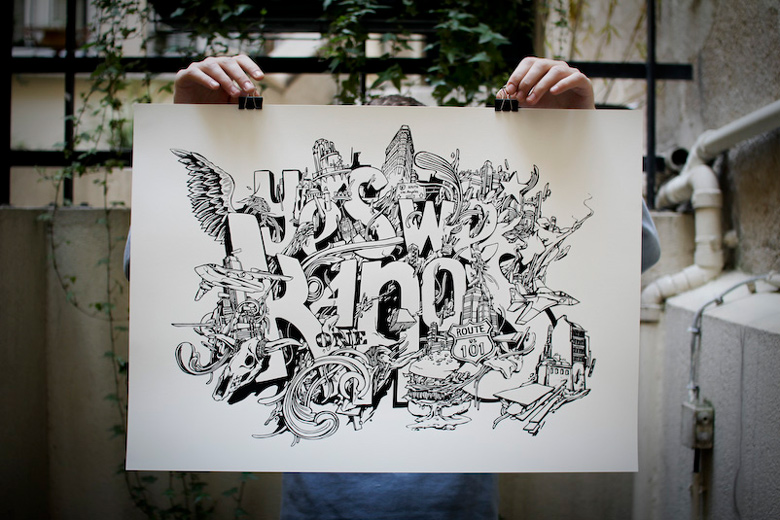
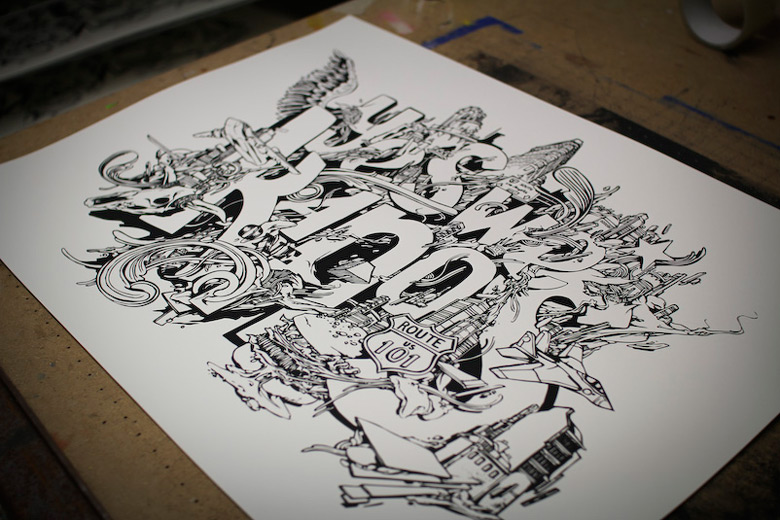
The title Yes We Kanos emerged as a playful reinterpretation of that slogan. Rather than producing a political poster, the intention was to create a personal visual response inspired by the atmosphere surrounding that historical moment. The artwork combines references to American culture, urban landscapes, industry, travel, and symbolism through a dense graphic composition built around recurring themes found throughout my work.
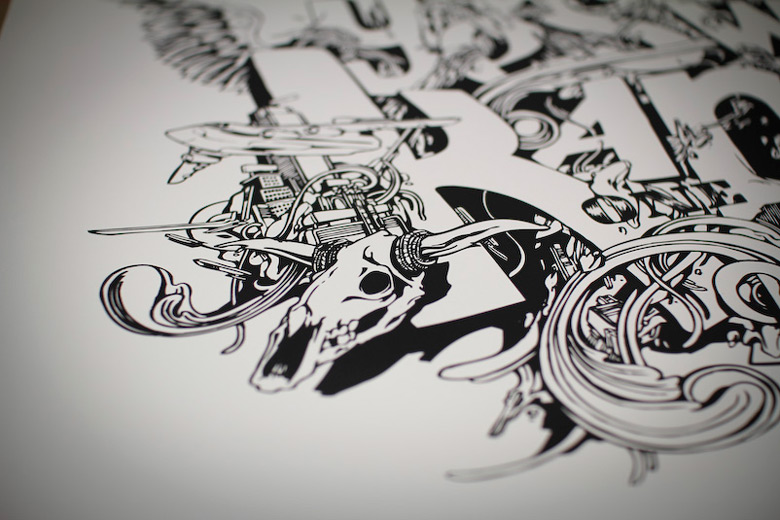
The image is constructed as a visual map of references associated with the United States. One of the most prominent elements is the cattle skull, a symbol strongly connected to the imagery of the American West. Over time, this motif became a recurring element in my visual vocabulary because of its ability to evoke travel, open landscapes, and cultural mythology.
Another key reference is the Route 101 highway sign. For anyone familiar with the American West Coast, Highway 101 immediately evokes California, road trips, movement, and the urban sprawl surrounding cities such as Los Angeles. The sign functions as a visual marker of mobility and exploration while connecting the artwork to personal travel experiences in the United States.
Urban architecture also plays a central role in the composition. Buildings, industrial structures, and fragments of cityscapes are integrated into the image, creating a connection between American metropolitan environments and the architectural themes that frequently appear throughout my murals, illustrations, and graphic design projects.
Organic forms weave through these urban structures, creating interactions between constructed environments and living systems. This dialogue between mechanical and organic elements is a recurring theme across many of my artworks and reflects an ongoing interest in transformation, growth, and mutation within contemporary cities.
A hamburger appears within the composition as another reference to American popular culture. Rather than functioning as a caricature, it acts as a recognizable cultural symbol embedded within a larger network of visual references. The objective was to assemble different aspects of American identity into a single interconnected image.
A prominent star also appears within the artwork. This element references the Lone Star associated with the state of Texas. The star functions as both a geographical symbol and a graphic device, reinforcing the broader American iconography present throughout the print.
An aircraft inspired by Air Force One is integrated into the composition as a reference to presidential power and the symbolic dimension of the American presidency. Within the context of the Obama era, this image carried a particularly strong resonance and contributed to the political undertones of the project.
Industrial structures also occupy an important place in the artwork. Petrochemical facilities and refinery-like constructions appear among the other elements, representing another aspect of American economic and industrial identity. Their inclusion creates a contrast between technological infrastructure and the more organic components of the composition.
Several graphic elements were directly inspired by illustrations found on United States dollar bills. These motifs had already appeared in some of my paintings and visual experiments. American currency contains a rich collection of symbols, decorative structures, engraved patterns, and allegorical imagery that lend themselves naturally to reinterpretation. By incorporating these references into the print, the composition establishes another layer of connection with American visual culture.
Although the artwork contains many references to the United States, it is not intended as a literal portrait of the country. Instead, it functions as a personal interpretation of a specific historical moment, combining political optimism, travel memories, urban imagery, industrial landscapes, and cultural symbols into a single composition.
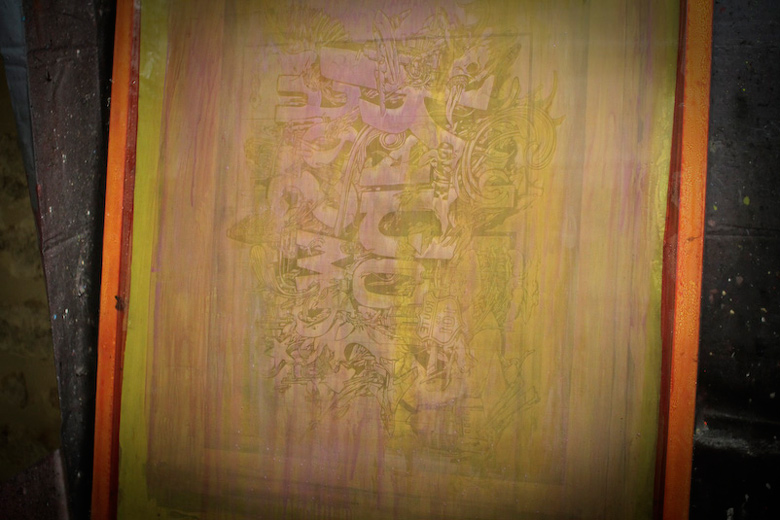
The project was produced as a limited edition screen print. The edition consisted of only 30 copies, printed in black and white. The choice of monochrome printing reinforced the graphic quality of the illustration and emphasized the complexity of the line work and visual details.
Each print was produced in a 50 x 70 cm format on Olin Rough 300 g/m² paper, chosen for its texture and ability to reproduce fine graphic elements with precision. The limited nature of the edition reflects the artisanal character of the project and the collaborative process behind its production.
Special thanks go to Andy and Jeanmi for their work on the screen-printing process and for helping bring the project from illustration to physical edition. Their expertise and involvement were essential to the realization of this limited edition release.
Frequently Asked Questions
What is Yes We Kanos?
Yes We Kanos is a limited edition screen print inspired by the cultural atmosphere surrounding Barack Obama’s election campaign and broader American imagery.
Why is the artwork called Yes We Kanos?
The title is a reinterpretation of the famous “Yes We Can” slogan associated with Barack Obama’s presidential campaign.
What American symbols appear in the artwork?
The composition includes a cattle skull, Route 101 sign, urban architecture, a hamburger, a Texas-inspired star, an Air Force One reference, petrochemical facilities, and elements inspired by dollar bill illustrations.
How many prints were produced?
The edition was limited to 30 screen prints.
What are the technical specifications of the edition?
The print was produced in black and white, measuring 50 x 70 cm, on Olin Rough 300 g/m² paper.