
Patrimoine Day 2012 / Villiers-le-Bel
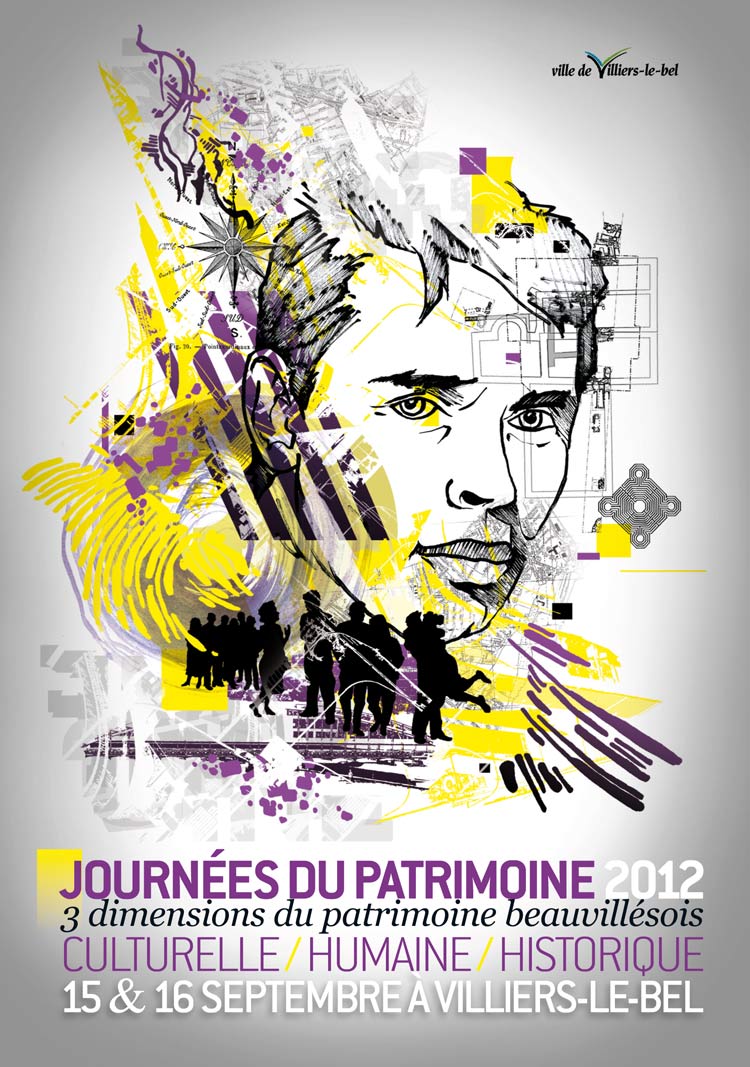
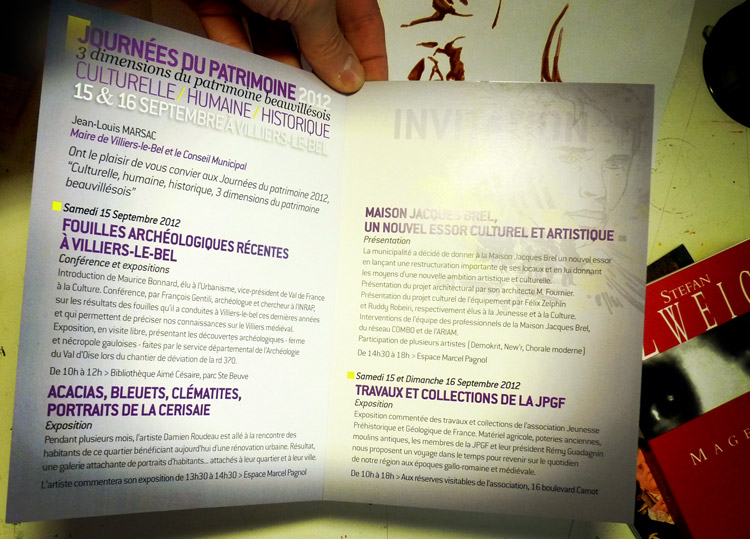
This project is a commissioned graphic design work created in 2012 for the Patrimoine day in Villiers-le-Bel. The work includes both a poster and a layout system developed for municipal communication around the event. The goal was to translate a cultural program into a structured visual identity combining heritage references, spatial organization, and public communication.
The main visual anchor is a portrait of Jacques Brel, reused as a structural element within the composition. It is not treated as a simple illustration but as a central graphic node around which other systems are organized.
The design integrates several heritage-related visual components. One of the key elements is the labyrinth symbol from the Cathedral of Amiens. Historically associated with heritage routes and monument visits, it introduces a logic of structured exploration and guided movement through cultural sites.
Architectural plans are also integrated into the composition. These simplified diagrams abstract built structures into readable graphic systems. They connect the event to the physical and historical fabric of the city of Villiers-le-Bel and its architectural environment.
Silhouettes of visitors are included to represent public interaction with heritage spaces. These figures introduce a human scale and reinforce the idea of active participation rather than passive observation.
A rose of winds is also part of the visual system. It functions as a navigation device, referencing orientation, direction, and spatial reading. It reinforces the idea of movement through cultural and historical points of interest.
All these elements are structured within a coherent graphic charter designed for the event. The system ensures consistency across different communication formats while maintaining distinct roles for each visual component.
The composition operates as a layered structure. The portrait provides identity, the labyrinth introduces historical navigation systems, architectural plans define spatial logic, visitor silhouettes introduce human presence, and the rose of winds establishes directional orientation. Together, they form a unified visual language for the event.
This project was commissioned by the municipality of Villiers-le-Bel as part of the 2012 Patrimony Days program. It required adapting a national cultural event into a local communication system specific to the city’s heritage and urban context.
The use of Jacques Brel as a visual reference continues a broader methodology in which portraiture is used as a structural rather than narrative device. This allows continuity across different municipal projects while adapting to different themes.
The labyrinth of Amiens introduces a historical system of spatial organization. In this context, it becomes a metaphor for navigating cultural heritage, where movement and orientation are central to the visitor experience.
Architectural plans function as abstract representations of space. They simplify complex structures into graphic forms that can be integrated into the visual identity system. This abstraction reinforces the idea of reading the city as a mapped and structured environment.
Visitor silhouettes reintroduce the social dimension of the project. They represent the public engaging with heritage spaces and reinforce the communicational purpose of the design.
The rose of winds completes the system by introducing directional logic and spatial reference, linking all elements into a coherent navigation-based visual structure.
Special thanks to Laurent Le Texier and the municipal team of Villiers-le-Bel for their collaboration on this and multiple related cultural projects.
Toggle title
What was the purpose of this project?
To design the official poster and graphic identity for the 2012 Patrimoine day in Villiers-le-Bel.
Which main visual elements were used?
A portrait of Jacques Brel, the labyrinth of Amiens, architectural plans, visitor silhouettes, and a rose of winds.
What does the labyrinth symbol represent?
It represents structured navigation through cultural heritage sites and monument exploration.
How are architectural plans used in the design?
They are abstracted into graphic elements representing spatial organization and urban heritage.
Who commissioned the project?
The municipality of Villiers-le-Bel as part of its 2012 Patrimoine Days communication campaign.