
CELLOGRAFF IN GRAFFITIART MAGAZINE
CELLOGRAFF IN GRAFFITIART MAGAZINE
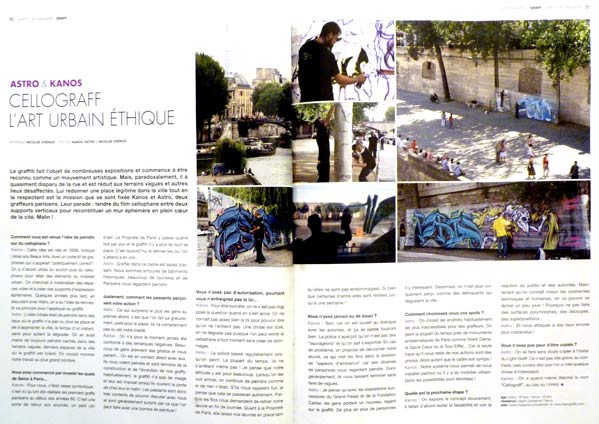
Graffiti is beginning to be recognized as an art movement and is the subject of numerous exhibitions. Paradoxically, it has all but vanished from the streets, relegated to vacant lots and abandoned sites. Restoring its legitimate place in the city—while respecting the urban environment—is the mission Kanos and Astro, two Parisian graffiti artists, have set for themselves. Their solution: stretching plastic wrap between two vertical supports to create an ephemeral wall right in the heart of the city. Clever!
How did you come up with the idea of painting on plastic wrap stretched across the street?
Kanos: The idea came to me in 2006, when I was at art school. With a graphic design collective called *Poétiquement Correct*, we first used packing tape and then plastic wrap to connect pieces of street furniture. We wanted to give physical form to empty spaces and create temporary canvases for expression. A few years later, while talking with Astro, we had the idea of revisiting that concept and applying it to graffiti. Astro: The initial idea was to paint in places where graffiti no longer belongs—or never did—and to reclaim the city for a moment without actually defacing it. We were tired of always painting in hiding within vacant lots—the last urban spaces where graffiti is tolerated. We wanted to show our work to a wider audience. You started by taking over the banks of the Seine in Paris…
Kanos: For us, it was quite symbolic: that’s where the first Parisian graffiti pieces were created in the early 80s. It’s a sort of return to our roots, a little nod to the past. Paris’s sanitation crews pass by four times a day, and graffiti has absolutely no place there anymore. Today, it’s the last place anyone would expect to see it. Astro: Painting in that setting is quite enjoyable. We’re surrounded by historic buildings; lots of tourists and Parisians watch us paint.
Speaking of which, how do passersby perceive what you’re doing?
Astro: What surprises people most at first is that we’re doing this for free—purely for the pleasure of it. The fact that it’s free is something that unsettles them; they don’t understand what we stand to gain. Kanos: We haven’t faced any negative comments so far. Lots of people take photos and talk to us… We’re in direct contact with them. They see us painting and witness the creation and evolution of our graffiti. Usually, graffiti is faceless—something imposed on people when they step out their front door in the morning. So, passersby are really happy to chat with us, and they’re generally amazed by what we can do with a spray can!
You don’t have a permit, yet you aren’t breaking the law…
Kanos: To be honest, we didn’t really think about that when we started. We don’t know the law well enough to say for sure that we aren’t breaking it. One thing is certain: we aren’t causing damage, since the cellophane can be removed at any time without leaving a mark. Astro: The police drive by regularly while we’re painting. Most of the time, they don’t even stop! I think our attitude plays a big part in that. When we see them coming, we just keep painting as if nothing is happening. If they saw us running away, I think things would play out differently. Sometimes the cops ask us to take our work down at the end of the day. As for the Paris sanitation department, they leave our pieces up as long as they aren’t damaged. In fact, some of them have stayed up for as long as a week!
You’ve never had any trouble? Kanos: No, because we’re open to dialogue with the authorities, and things always go smoothly. The police realize we aren’t just hooligans and that we know how to articulate ourselves. If an issue arises, we offer to take down our work; that puts the cops in the position of being “buzzkills,” since dozens of people are watching us paint. So, generally, they let us finish without making a fuss. Astro: I think that with the successive exhibitions at the Grand Palais and the Fondation Cartier, people are seeing graffiti in a new light. More and more people are taking an interest in it. We’re no longer viewed solely as delinquents defacing the city.
How do you choose your spots?
Astro: We choose locations that are usually inaccessible to graffiti artists. Most of the time, we paint near iconic Parisian landmarks like Notre-Dame, Sacré-Cœur, or the Eiffel Tower… because photos are the only trace left of our actions. So, the setting might as well be nice! Kanos: Our system allows us to set up wherever there’s street furniture. So, the possibilities are limitless!
For now, you’re sticking to reproducing temporary walls. What’s the next step?
Kanos: We’re exploring the concept gradually. First, we had to test feasibility and gauge the reaction of the public and the authorities. Now that we have a better grasp of the technical and logistical constraints, we can really let loose! Why not try polymorphic surfaces, cutouts, layering… Astro: And tackle even more unexpected locations!
Aren’t you worried about being copied?
Astro: We’ll probably get copied, just like with Light Graff. It’s not a big deal; on the contrary, it would mean we’ve created something interesting.
Kanos: We did register the Cellograff trademark, though just in case! (laughs).