
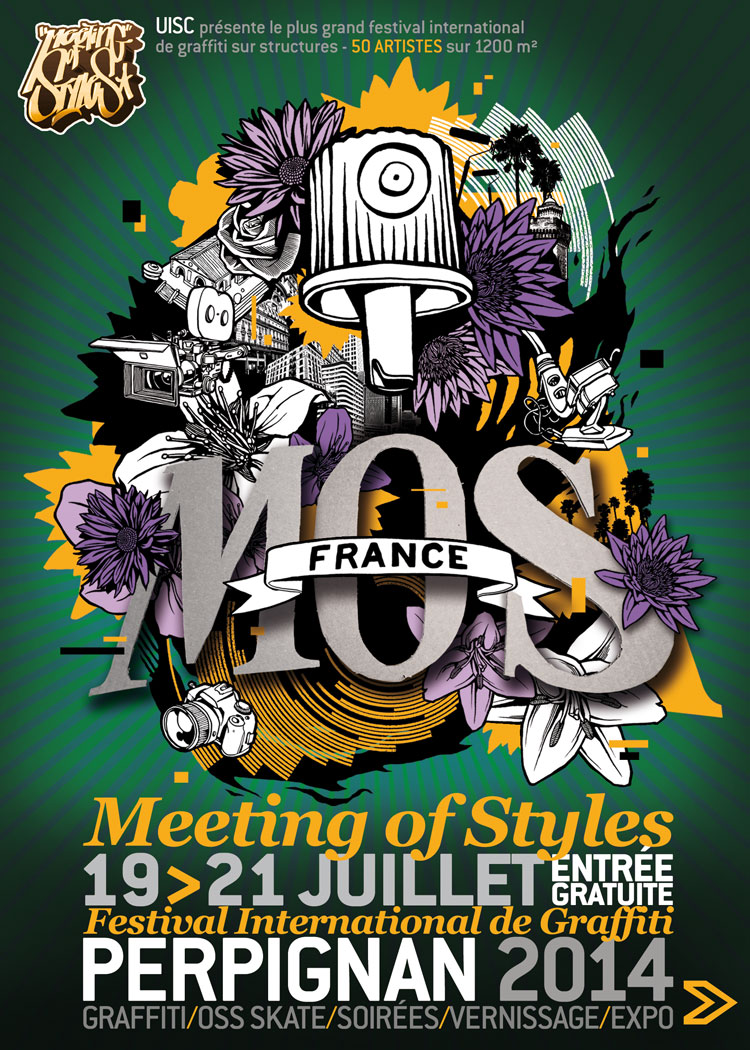
Meeting of Styles France 2014 – Official Visual Identity
Perpignan le 19, 20 & 21 July 2014 for Meeting of styles FRANCE.
For this edition of Meeting of Styles France 2014 in Perpignan, I was responsible for the official visual communication of the festival. This included the creation of the official poster, the complete visual identity system, as well as motion design elements used for video communication and digital promotion.
My work covered all major communication assets of the event, ensuring a coherent visual language across print, web and animated media. The goal was to translate the energy of the international graffiti festival into a structured graphic identity capable of representing both the diversity of artists and the intensity of live painting performances.
Meeting of Styles is an international graffiti and street art platform that brings together artists from all over the world. The Perpignan edition is one of the key European gatherings, transforming the city into a large-scale open-air exhibition space. For this reason, the visual identity needed to reflect both the raw energy of street culture and the organization of a major international cultural event.
The poster design was built around strong graphic contrasts, urban textures and typographic elements inspired by street culture aesthetics. The motion design extended this visual system into animation, allowing the identity to move and evolve across digital platforms. This approach reinforced the dynamic nature of the festival, where artworks are constantly created live in front of the public.
Beyond the 2014 edition, this collaboration is part of a longer relationship with Meeting of Styles France. I had already worked on the official communication of the festival in 2012 and 2013, developing previous visual identities and adapting the graphic language from one year to the next. Each edition required a new interpretation while maintaining continuity with the identity of the event.
In 2015, I also participated in the festival as an artist, painting directly within the event space alongside international graffiti writers. This dual experience, both as a designer and as a participating artist, gave me a deeper understanding of the ecosystem behind the festival and the balance between visual communication and artistic production. I also went to mos in London UK and Wiesbaden Germany years before.
The visual identity created for the 2014 edition is part of a broader reflection on how graphic design interacts with urban culture. Festivals like Meeting of Styles exist at the intersection of institutional communication and underground artistic expression. The challenge is to create a visual system that remains accessible, impactful, and faithful to the spirit of graffiti culture.
The design work also included animated elements used in promotional videos and digital content. These motion sequences were designed to amplify the presence of the festival online and provide a more immersive experience of the visual identity. The integration of movement was essential, reflecting the performative aspect of live painting events.
This project highlights the importance of coherence in cultural communication. Poster design, digital visuals and motion graphics were treated as parts of a unified system rather than isolated outputs. Each element contributed to building a recognizable identity for the festival.
Meeting of Styles Perpignan 2014 remains a key reference in my work as a graphic designer working within the field of street art and urban culture. It represents a convergence of design, graffiti, and cultural event communication at an international level.
Frequently Asked Questions
What is Meeting of Styles 2014?
It is an international graffiti festival held in Perpignan, France, bringing together artists from around the world.
What did Alex Kanos create for the event?
He designed the official poster, visual identity system, and motion design elements for the festival.
Did Alex Kanos work on other editions?
Yes, he worked on the communication for the 2012 and 2013 editions and as an artist in UK and Germany before.
What was the goal of the visual identity?
To translate the energy of graffiti culture into a structured and coherent graphic system for print and digital media.
Was motion design part of the project?
Yes, animated elements were created to support digital communication and video promotion.